
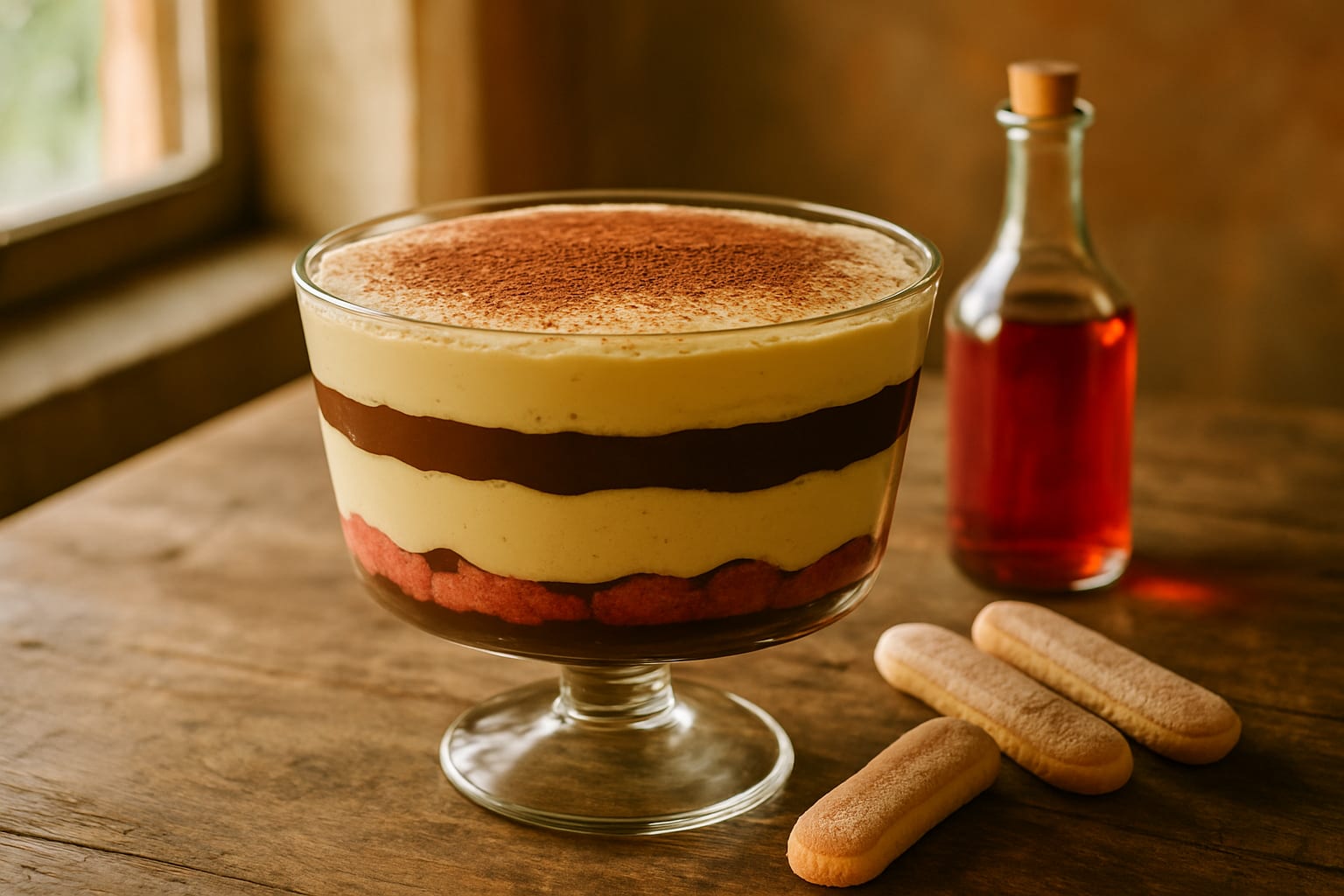
When I was a girl in Emilia-Romagna, zuppa inglese meant Sunday was truly Sunday. My mother kept a squat little bottle of Alchermes on the top shelf, its red so bright it looked bewitched, and she only brought it down for feast days and birthdays. I remember standing on a stool to watch her paint the sponge fingers pink with a pastry brush, scolding me gently when I tried to lick the bowl of warm custard before it had cooled. The name always puzzled me as a child — ‘English soup’ — and it was years before I learned it likely came from English trifle, reimagined by our nonne with their own custard and that unmistakable crimson liqueur. We never used a fancy trifle bowl; a simple glass dish or juice glasses did just fine, so you could see every honest layer of cream, chocolate and soaked sponge. My grandchildren now beg for it whenever the table is set for company, and I tell them the same thing my mother told me: the red is for love, and the layers are for patience. Follow this zuppa inglese recipe step by step and bring the flavours of Emilia-Romagna into your kitchen.
Ingredients
Method
- Pour the milk into a heavy-bottomed saucepan and add the split vanilla pod along with the lemon zest. Warm it gently over medium-low heat until small bubbles just start to form around the edges, then take it off the heat and let it sit for ten minutes so the flavours can steep. This quiet infusion is what separates a custard that merely tastes sweet from one that tastes like something your grandmother made with love. Fish out the vanilla pod and zest before moving on, but don’t discard the pod — dry it and bury it in your sugar jar for weeks of vanilla sugar afterward.
- In a large bowl, whisk the egg yolks and sugar together vigorously until the mixture turns pale and almost doubles in volume, about two to three minutes by hand. This step dissolves the sugar crystals into the yolks and begins to trap tiny air bubbles that give the finished custard its silky, cloud-like texture. Sift in the flour and the pinch of salt, then whisk again until you have a smooth, lump-free paste. Do not rush this — any stray lumps of flour now will haunt your custard later.
- Slowly pour the warm infused milk into the yolk mixture in a thin stream, whisking constantly so the eggs warm gradually instead of scrambling. Return everything to the saucepan and cook over medium-low heat, stirring continuously with a wooden spoon or whisk, until the custard thickens enough to coat the back of the spoon, roughly six to eight minutes. Keep the heat gentle and never let it come to a hard boil, or the eggs will curdle and grain the whole batch. When it’s ready, it should fall from the spoon in a slow, thick ribbon.
- Immediately pour the hot custard through a fine sieve into a clean bowl to catch any small lumps, then divide it evenly between two bowls. Leave one bowl as your plain vanilla custard. Into the other, stir in the chopped dark chocolate or cocoa powder while the custard is still warm, whisking until it melts completely into a glossy, deep brown cream. Press a piece of plastic wrap directly onto the surface of both custards to stop a skin from forming, then let them cool to room temperature before chilling.
- In a shallow dish wide enough to dip the ladyfingers, combine the Alchermes, dark rum and water. This dilution matters more than it seems — undiluted Alchermes is intensely sweet and boldly perfumed, and without the water your sponge will turn soggy and overpowering rather than delicately flavoured. Taste a spoonful; it should taste vividly of cherry and spice but not make you wince. Set the dish beside your assembly glasses so you can work quickly once you begin layering.
- Dip each ladyfinger briefly into the soaking liquid, no more than a second or two per side, so it drinks in colour and flavour without falling apart in your hands. Arrange a layer of soaked ladyfingers in the bottom of your serving glasses or a glass dish, breaking pieces as needed to fit snugly against the edges. Speed is your friend here, as the biscuits soften quickly once wet, so have your custards ready and nearby before you start dipping.
- Spoon a layer of vanilla custard over the soaked sponge, spreading it gently to the edges, followed by a layer of chocolate custard on top. Repeat with another layer of soaked ladyfingers, then vanilla, then chocolate, until you reach the top of your glasses or dish, finishing with a layer of custard rather than sponge. The alternating stripes of pink-tinted sponge, pale cream and dark chocolate are the whole beauty of zuppa inglese, so take a moment to make each layer level and distinct.
- Cover the glasses or dish with plastic wrap and refrigerate for at least four hours, though overnight is even better. This resting time lets the layers firm up and the flavours marry, as the custard slowly draws a little more moisture from the sponge and the Alchermes mellows into the cream rather than sitting sharply on top of it. Resist the urge to serve it too soon; an underchilled zuppa inglese will slump rather than hold its handsome layers.
- Just before serving, dust the top lightly with a little extra cocoa powder or grated dark chocolate for contrast. Bring the glasses to the table still cold from the refrigerator so guests can see the layers through the glass before the first spoonful disappears them. Serve with a small spoon and let everyone dig straight down through all three layers at once — that first bite of sponge, cream and chocolate together is the whole point of this dessert.