
In my mother’s kitchen in the countryside near Modena, the arrival of Christmas Eve was never announced by the tree or the lights in the piazza — it was announced by the smell of a capon simmering slowly since morning, and by the sight of every woman in the family seated around the big wooden table, pleating tiny rounds of dough with the tips of her fingers. Nonna Fiore remembers standing on a stool as a small girl, too short to reach properly, folding her clumsy tortellini beside her grandmother’s perfect ones, and being told that even the crooked ones would taste just as good once they were swimming in broth. This is the dish Emilia-Romagna guards most jealously. Bologna and Modena have argued for centuries over whose version is the true one, but every family agrees on this much: real tortellini are tiny, no bigger than a fingernail, filled with a whisper of pork, prosciutto, mortadella and Parmigiano, and served only in a clear, golden broth that has been coaxed from bone and capon for hours, never rushed. Nonna Fiore insists the secret is patience, not skill — and an evening spent with family and floured hands, telling the same stories you told last year. Follow this tortellini in brodo recipe step by step and bring the flavours of Emilia-Romagna into your kitchen.
Ingredients
Method
- Everything in this dish depends on the broth, so begin here, ideally the day before. Place the capon (or the beef and chicken pieces and bones) into a large stockpot with the onion, carrots, celery and parsley, then cover generously with cold water — starting with cold water is important, as it allows the proteins to release slowly into the liquid rather than seizing up and clouding it. Bring everything to the barest simmer, never a rolling boil, and skim off the grey foam that rises in the first twenty minutes. Let it whisper away, partially covered, for three to four hours, topping up with a little water if it reduces too far. Season with salt only near the end. Strain the broth through a fine sieve or muslin cloth, discard the solids (or save the meat for another meal), and let it cool. If you have time, chill it overnight so you can lift off the layer of fat that rises to the top, leaving a broth that is clear, light and deeply savoury.
- Melt the butter in a small pan and gently brown the diced pork loin on all sides until cooked through and lightly golden — this step matters more than it seems, because raw pork would leave the filling pale and flat-tasting, while browning develops a deep, roasted flavour that carries through even the smallest morsel of filling. Let the pork cool completely, then chop it very finely by hand or pulse it in a food processor along with the prosciutto and mortadella until you have a fine, even paste rather than a rough mince. Transfer this to a bowl and work in the grated Parmigiano, the egg, a generous grating of nutmeg, and salt and pepper to taste. Mix thoroughly until the filling holds together like a soft, dense paste. Cover the bowl and rest it in the refrigerator for at least twelve hours, or overnight — this resting time lets the flavours of the cured meats, cheese and spice properly marry, so do not be tempted to skip it, even if your patience wears thin.
- Mound the flour on a clean work surface and make a well in the centre. Crack the eggs into the well and, using a fork, gradually draw the flour in from the edges, working outward to inward until a shaggy dough forms. Knead by hand for a good ten minutes, pressing firmly with the heel of your palm, folding, and turning, until the dough becomes smooth, elastic and slightly glossy — it should spring back gently when pressed. Wrap it tightly in cling film and let it rest at room temperature for at least thirty minutes; this relaxes the gluten you have just worked so hard to develop, making the dough far easier to roll out thin without tearing or fighting back.
- Divide the dough into two or three manageable pieces, keeping the ones you are not using wrapped so they do not dry out. Using a rolling pin or a pasta machine, roll each piece out into a very thin sheet — thin enough that you could almost read a newspaper through it, as the old Bolognese saying goes. This is not an exaggeration: tortellini wrappers that are too thick will taste doughy and gummy once cooked in broth, overwhelming the delicate filling inside. Work quickly once the sheet is rolled, keeping it lightly covered with a clean cloth, because egg pasta dries out and becomes brittle within minutes of exposure to air.
- Using a small round cutter or the rim of a glass, cut the sheet into squares or rounds about 3 to 4 cm (roughly 1.5 inches) across — smaller than you think you need, since real tortellini are famously tiny. Place a small dab of filling, no bigger than a chickpea, in the centre of each. Fold the pasta over into a triangle or half-moon, pressing the edges firmly to seal out all the air, then bring the two outer corners around and pinch them together over your fingertip, curling the pasta into its distinctive little ring. This is the shape legend says was inspired by the navel of Venus herself, and the pinch of your fingertip is what gives it that soft, rounded belly. Lay the finished tortellini on a floured tray in a single layer as you go, so they do not stick together.
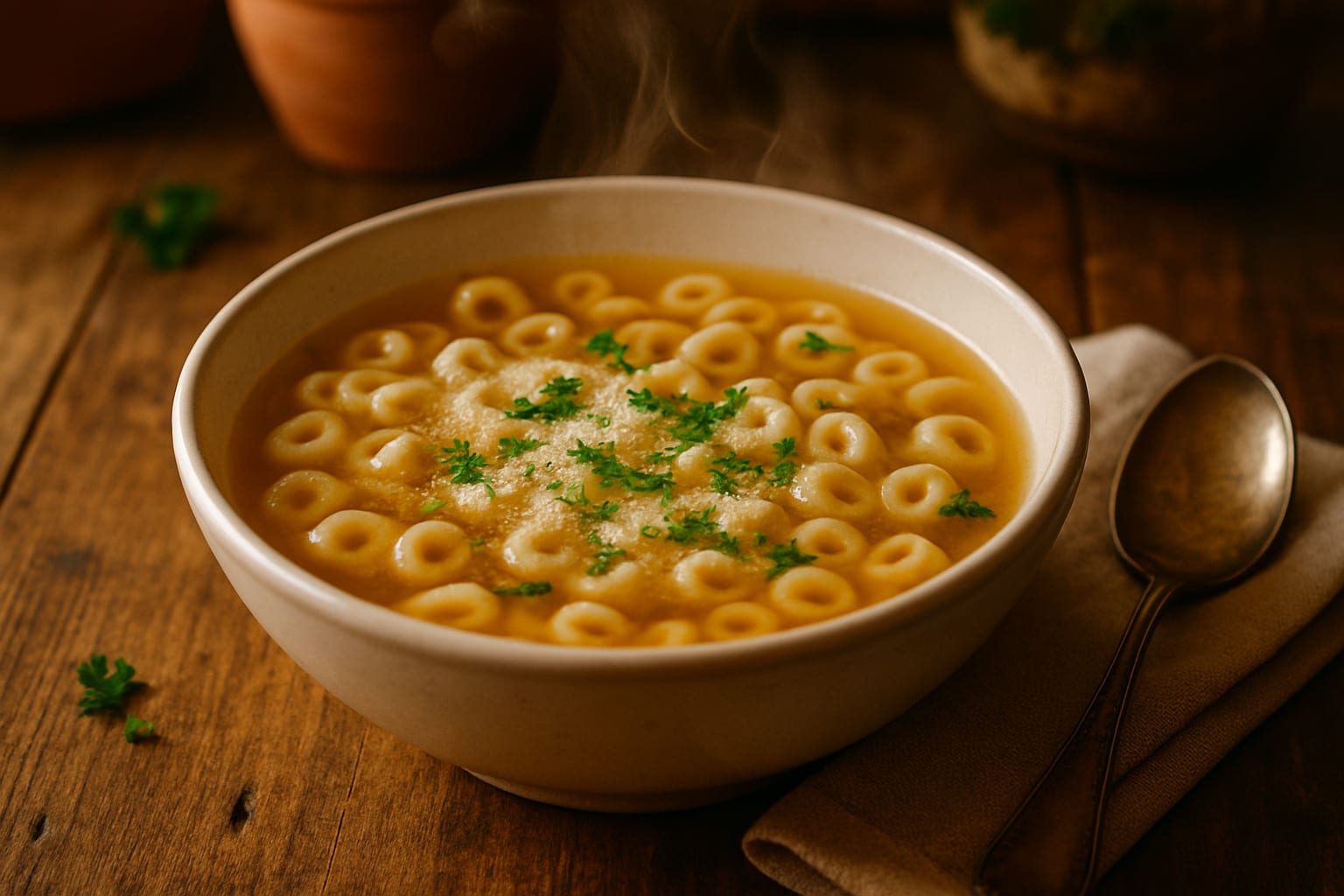
- Bring the strained, defatted broth to a gentle simmer in a wide pot. Slide in the tortellini and cook them directly in the broth — never in separate salted water — for three to five minutes, until they float to the surface and the pasta is tender but still has a slight bite. Cooking them in the broth itself means they absorb its flavour as they finish, rather than diluting it with pasta water. Ladle the tortellini and broth immediately into warmed bowls, finishing each with a generous dusting of freshly grated Parmigiano Reggiano. Serve at once, while the steam still rises, exactly as it has been done on Christmas Eve tables across Emilia-Romagna for generations.