
On the road between Rimini and Cesena, my zia Assunta kept a little chiosco where she sold nothing but piadina, and I spent every summer of my girlhood standing on a crate beside her, watching her hands. She never measured anything — a mountain of flour on the wooden board, a well in the middle, a spoonful of lard worked in with her fingers until it disappeared. The women of Romagna who made piadina for a living were called azdore, and they were treated like royalty in our village, because a truly good piadina, thin and spotted with char, blistered but still soft enough to fold, is harder to make than it looks. My zia cooked hers on a terracotta testo blackened by forty years of fire, and she could tell it was ready just from the smell of the stone. She would slap the dough down, flip it with her bare fingers, and hand it to me still steaming, torn open and stuffed with whatever we had that day. That smell — scorched flour and woodsmoke — is Romagna to me more than any painting or postcard could ever be. Follow this piadina romagnola recipe step by step and bring the flavours of Emilia-Romagna into your kitchen.
Ingredients
Method
- Tip the flour onto a large wooden board or into a wide bowl and mound it up the way my zia always did, then push a deep well into the centre with your fist. Scatter the salt and baking soda around the rim rather than dropping them straight into the well, so they don’t hit the liquid all at once and leaven unevenly. This old-fashioned well method isn’t just theatre — it lets you draw the flour in gradually from the edges, which keeps the dough from turning lumpy or overworked before it’s even wet.
- Add the softened lard to the well and begin rubbing it into the flour with your fingertips, as if you were making pastry, until the mixture looks like coarse, damp breadcrumbs. Lard is the soul of a true piadina romagnola — it’s what makes the bread tender and lets it fold without cracking, so don’t rush this step or leave streaks of fat unblended. If you’re using olive oil instead, simply drizzle it in and work it through the same way; the dough will be a little less rich but still good.
- Pour in the lukewarm water a little at a time, drawing the flour in from the edges with a fork or your fingers until a shaggy dough forms. Turn it out and knead firmly for eight to ten minutes, pressing with the heel of your hand and folding it back over itself, until the dough is smooth, elastic, and no longer sticky. Your arms will tire before the dough tells you it’s ready — trust the clock as much as the feel, because a well-kneaded piadina dough is what keeps the finished bread pliable enough to fold around a filling later.
- Shape the dough into a ball, cover it with an upturned bowl or a clean cloth, and let it rest at room temperature for thirty minutes. This isn’t about rising, since there’s little or no leavening at work here — it’s about letting the gluten relax after all that kneading, so the dough won’t fight back and spring shut when you try to roll it paper-thin. Resist the urge to skip this step even when you’re hungry and impatient; I promise the piadina will thank you for your patience.
- Divide the dough into six equal pieces and roll each into a ball. On a lightly floured surface, roll each ball out into a thin round about 20-22cm (8-9 inches) across, turning it a quarter turn between passes of the pin so it stays even and round rather than oval. A true Romagna piadina should be thin enough to see the shadow of your hand through it, so keep rolling a little past where you think you should stop. Stack the rolled rounds between sheets of parchment or a floured cloth so they don’t dry out while you work through the batch.
- Set a testo, or in its absence a cast-iron or heavy nonstick skillet, over medium-high heat until a few drops of water flicked onto the surface dance and evaporate instantly. Piadina needs real heat from the very first second it touches the pan, or it will turn tough and leathery instead of tender with those characteristic dark freckles. Do not grease the pan — the dough has enough fat in it already, and a dry surface is what gives you the proper scorched patches.
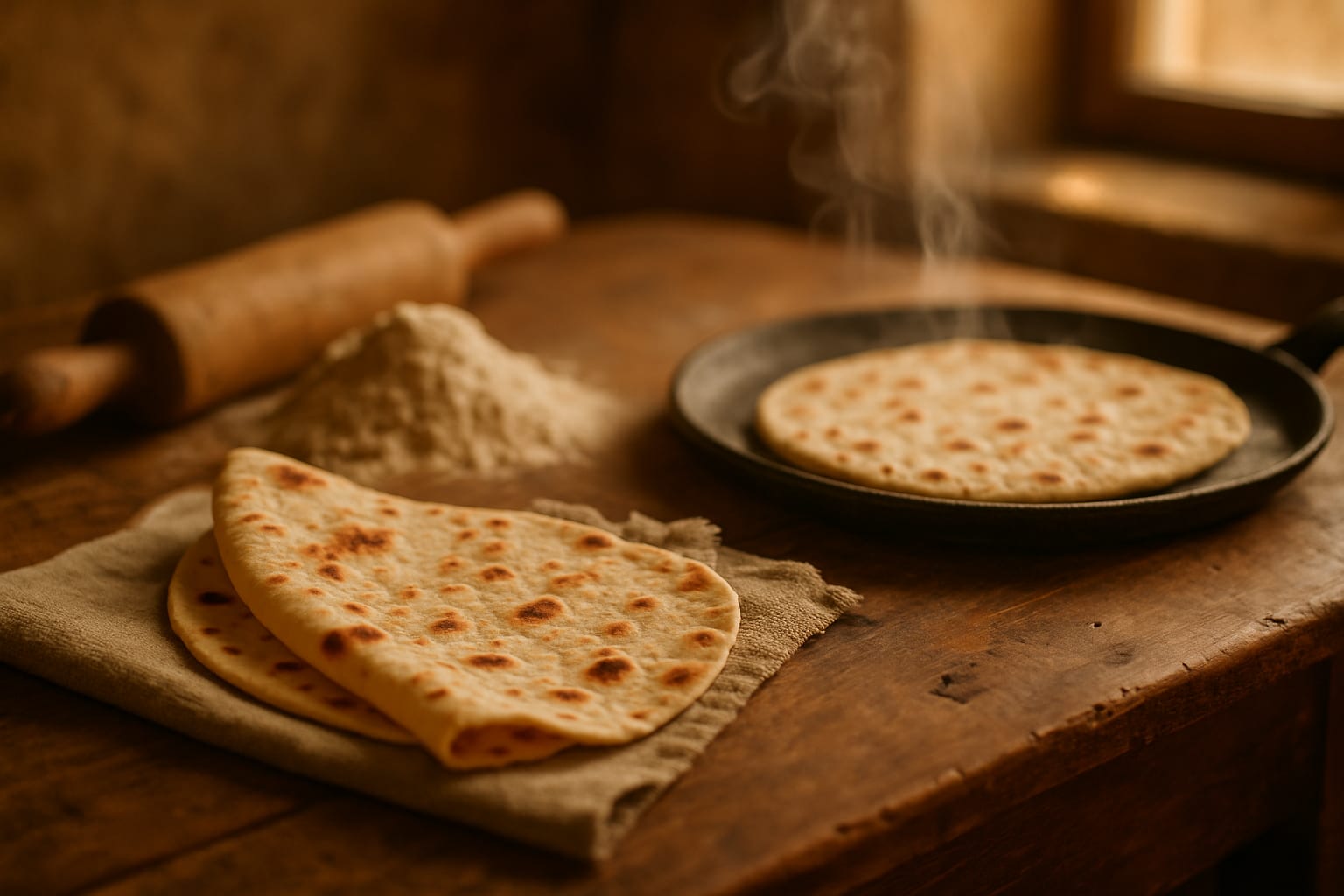
- Lay a rolled round into the hot pan and prick it all over with a fork to stop it puffing up like a balloon. Cook for one to two minutes until the underside is speckled with brown spots, then flip with a wide spatula and cook the second side the same way, pressing gently on any stubborn bubbles. Stack the finished piadine under a clean towel to keep them soft and warm while you cook the rest. Serve them warm, split open while still pliable, and filled simply with squacquerone, a few folds of prosciutto, and a scattering of rucola, or with whatever good things you have in the kitchen that day.