
When I was a girl in the hills below Torino, my grandmother kept a little copper pot just for panna cotta, and no one else was allowed to touch it — not even to wash it. She said the metal remembered the cream, and I believed her, the way children believe every small magic their nonna tells them. On Sundays after Mass, while the men argued about football and the aunts gossiped over coffee, she would slip into the kitchen and warm the cream slowly, never boiling it, humming some old song from the Langhe hills where she was born. We would watch the little glass cups tremble as she carried them to the cold cellar to set, and the waiting felt like the longest part of the week. When the caramel finally slid down the sides like amber silk, my cousins and I fought over who got to lick the spoon. Panna cotta means simply cooked cream, but in Piemonte it means so much more — patience, restraint, the confidence to let three humble ingredients speak for themselves. It is dessert as quiet dignity, the way the Piemontesi themselves so often are. Follow this panna cotta recipe step by step and bring the flavours of Piemonte into your kitchen.
Ingredients
Method
- If you are using powdered gelatin, sprinkle it evenly over the three tablespoons of cold water in a small bowl and let it sit for five to ten minutes until it looks like wet sand, thick and spongy. If you are using sheets, drop them into a bowl of very cold water and let them soften completely, then lift them out and squeeze away the excess water with your fingers. Blooming first is not a step you can skip, my dears — gelatin added dry or straight into hot cream will clump into little rubbery threads instead of dissolving smoothly, and no amount of stirring will save it after that.
- In a heavy-bottomed saucepan, combine the cream, milk, sugar, salt, and the scraped vanilla bean along with its pod. Set the heat to medium-low and warm the mixture gently, stirring now and then with a wooden spoon, until the sugar has fully dissolved and the cream is steaming but nowhere near a boil. My grandmother always said panna cotta is ruined by impatience — if you rush the heat, the cream can taste faintly scorched or separate later in the mold, so let it take its unhurried time.
- Remove the saucepan from the heat and fish out the vanilla pod. Add the bloomed gelatin to the warm cream and whisk gently until it has completely melted into the liquid, with no streaks or lumps remaining. The cream should still be warm enough to dissolve the gelatin fully but not so hot that it damages its setting power, so work quickly and calmly once it comes off the stove.
- Pour the mixture through a fine mesh sieve into a large measuring jug or bowl with a spout. This little step catches any stray bits of undissolved gelatin, vanilla seeds that clumped together, or a thin skin that may have formed on the surface. It is the difference between a panna cotta that feels rustic and one that feels like it came from a fine pasticceria in Torino — smooth as satin on the tongue.
- Divide the strained cream evenly among six ramekins, dariole molds, or simply pretty glass cups if you plan to serve it without unmolding. Let the cups cool on the counter for about fifteen minutes, then cover each with plastic wrap and transfer them to the refrigerator. Chill for at least six hours, though overnight is truly best, until the panna cotta is firm to a gentle touch at the center but still trembles like a shy bride when you tap the cup.
- In a small, light-colored saucepan, combine the sugar and water and set over medium heat without stirring, swirling the pan occasionally instead. Cook until the syrup turns a deep amber color, watching closely near the end because caramel can go from golden to burnt in a matter of seconds. Remove from the heat and carefully whisk in the warmed cream — it will bubble up furiously, so stand back — then stir until smooth and let it cool to room temperature before using.
- To turn the panna cotta out, dip each mold briefly in a bowl of very hot water for just a few seconds, taking care not to let water reach the cream itself. Run a thin knife around the edge, place a dessert plate on top, and invert the two together with one swift, confident motion, giving a gentle shake if needed. If it wobbles a little as it slides free, that is exactly as it should be — a stiff panna cotta has been overcooked or over-set, not perfected.
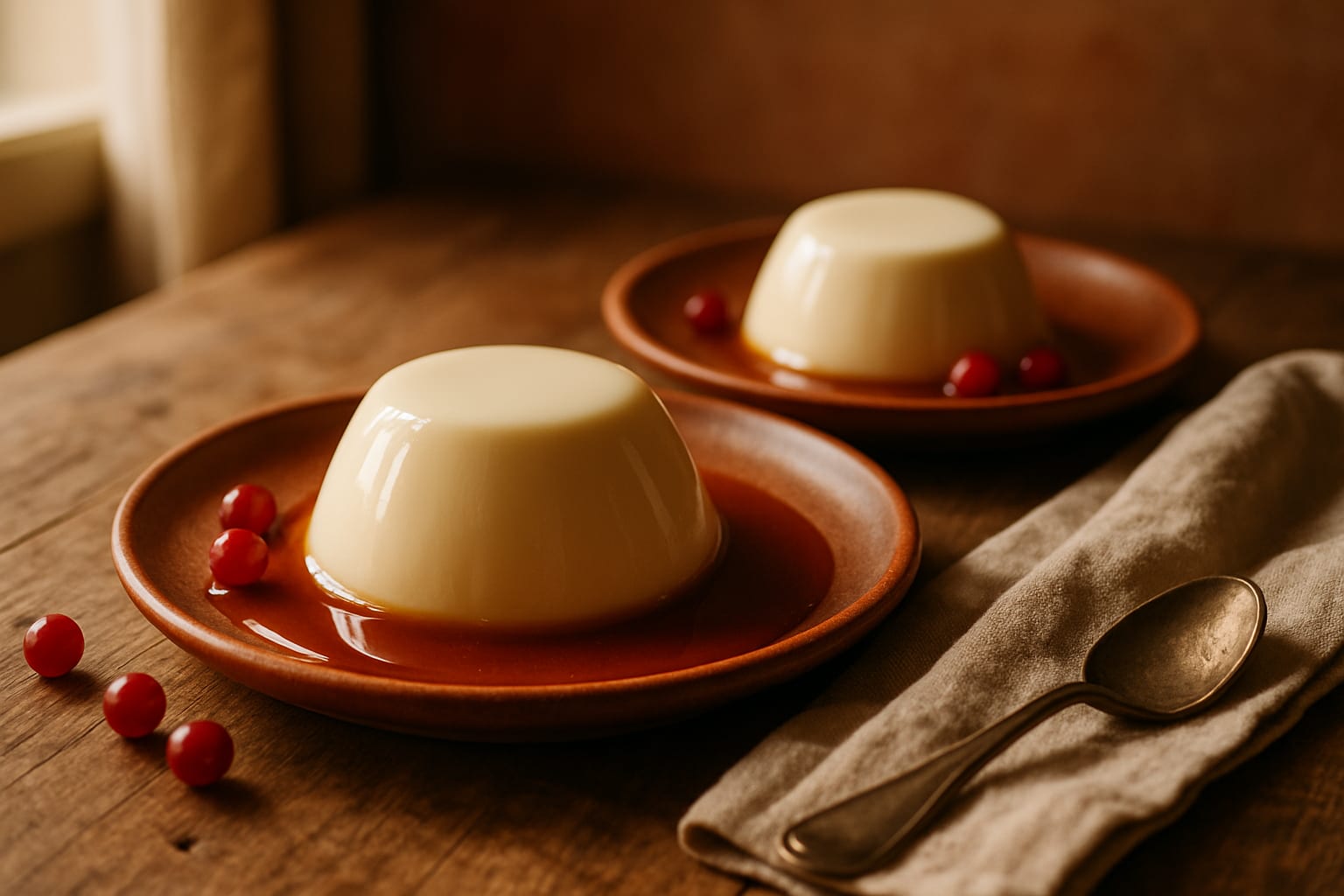
- Spoon the cooled caramel sauce generously over each dome, letting it pool around the base like a little amber lake, or finish with the bright berry coulis instead for a lighter, tart contrast. Serve immediately while the cream is at its coolest and silkiest. In my house we always set out both sauces, because someone always wants the one you did not make.