
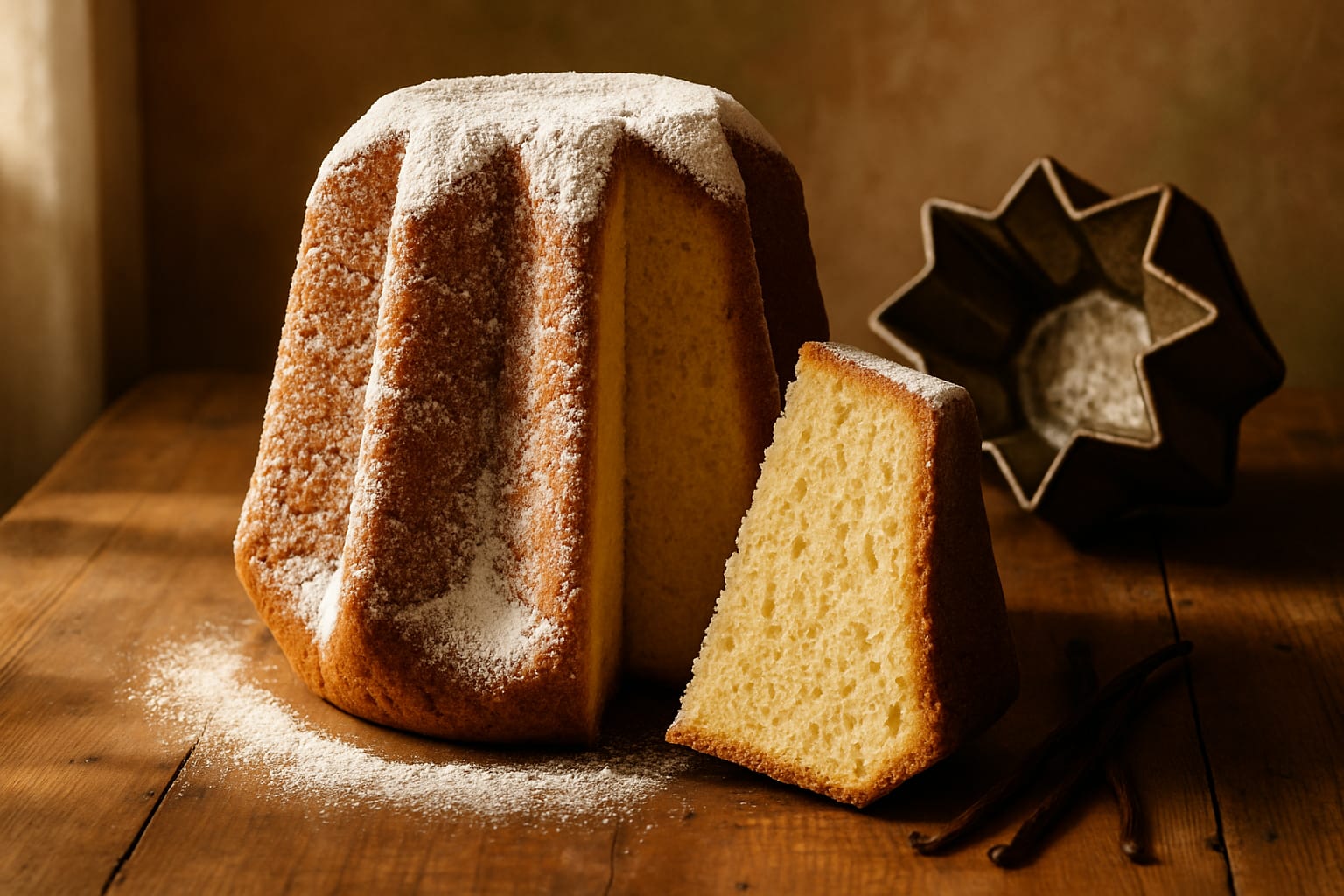
In our house in the hills above Verona, Christmas Eve smelled of butter and vanilla long before anyone spoke the word presepe. My grandmother Fiore kept a battered tin star mold that had belonged to her own mother, its ridges worn smooth from decades of buttering and flouring. She loved to tell us that pandoro was Verona’s proudest gift to the world, born the year a pastry maker asked a painter to help him shape a star out of dough, and the whole city fell in love with it. Unlike the panettone of our Milanese cousins, our pandoro carries no candied fruit and no raisins, just eggs, butter, sugar, and patient hours of rising, so the crumb turns soft and golden as a Christmas morning sky. Nonna Fiore always began two days before the holiday, waking before dawn to feed her dough like a small, sleepy creature, folding in butter bit by bit until the kitchen smelled like a bakery in heaven. When at last she turned the star free from its mold and dusted it white with vanilla sugar, we children fought over who got the pointed tip, sworn to be the sweetest bite of all. Follow this pandoro recipe step by step and bring the flavours of Veneto into your kitchen.
Ingredients
Method
- The night before you plan to bake, whisk the yeast into the warm milk with a spoonful of the sugar and about 120 g of the flour, then cover it and let it sit at room temperature overnight. This little sponge wakes the yeast gently and begins building flavour long before the rich dough goes to work, so you need far less yeast overall and the finished pandoro tastes deeper and less flat and sugary. By morning it should be puffed, bubbly, and smell faintly of beer and bread, which tells you it is alive and ready. Do not skip this stage, it is the quiet backbone of the whole recipe.
- In a stand mixer fitted with the dough hook, combine the starter with the remaining flour, sugar, eggs, egg yolks, honey, vanilla, lemon zest, and salt. Knead on low to medium speed for a full 15 to 20 minutes, much longer than an ordinary bread dough, because all that butter and egg richness still to come needs a very strong, well-developed gluten net to hold it up. The dough will look wet and shaggy at first and then slowly tighten into a smooth, glossy, elastic mass that pulls cleanly from the bowl. Be patient here, rushing this step is the most common reason home pandoro turns out squat and dense instead of tall and feathery.
- With the mixer still running on low, add 200 g of the softened butter a spoonful at a time, waiting for each piece to disappear into the dough before adding the next. This slow addition keeps the gluten strands intact instead of tearing them, so the butter coats the strands rather than pooling and breaking the structure. Keep kneading until the dough is silky, supple, and only slightly sticky, which can take another 10 minutes. Cover the bowl and let the dough rest at room temperature until it has doubled, roughly 2 to 3 hours.
- Deflate the risen dough gently, shape it into a rough rectangle, and refrigerate it for 30 minutes so it firms up enough to handle. Roll it out on a floured surface, dot the surface with the remaining 100 g of cold butter cut into thin slices, then fold the dough over itself in thirds like a letter. Roll and fold two more times, chilling for 20 minutes between each turn if the butter starts to soften. This is not true croissant-style lamination, but the same principle, cold butter folded between layers of dough, is what gives real pandoro its famous feathery, pull-apart crumb, so treat it with the same care and patience even in this simplified home version.
- You will need an actual eight-pointed pandoro star mold for this recipe, there is no good substitute that gives the true shape, though a tall panettone paper mold will bake a passable round version in a pinch. Butter the pandoro mold heavily, right into every ridge and point, then dust it with flour and tap out the excess, because the dough must release cleanly after its long rise. Shape the chilled dough into a smooth, taut ball by tucking the edges underneath, then drop it seam side down into the prepared mold. It should fill the base by no more than a third, it has a long way still to rise.
- Cover the mold loosely and set it somewhere warm and draft-free, an oven with just the light on works well. Now comes the real test of nonna’s patience, the dough must climb slowly until it reaches close to the top of the mold, which can take anywhere from 4 to 8 hours depending on the warmth of your kitchen. Resist the temptation to add more yeast to speed things along, a slow rise gives the yeast time to develop real flavour instead of just gas, and a pandoro rushed with extra yeast tastes thin and yeasty rather than rich and buttery.
- Heat your oven to 160°C (325°F) and place the mold on a baking sheet on a low rack, since pandoro browns quickly on top while its dense, buttery centre needs more time. Bake for 35 to 40 minutes, tenting loosely with foil after the first 15 minutes if the top is colouring too fast. It is done when a skewer inserted deep into the centre comes out clean and the cake sounds hollow when tapped on its base. Every oven runs differently, so start checking a little early the first time you make it.
- Let the pandoro cool in its mold for 10 minutes, then turn it out onto a wire rack, ideally resting star-point down in a tall container so it keeps its shape while it cools completely, which takes a couple of hours. Once fully cool, sift the vanilla-scented powdered sugar generously over every point and ridge until it looks dusted with fresh snow. Slice it from the top down through the centre so each piece reveals the soft golden star at its heart. Wrapped well, it keeps beautifully for several days, and many say it tastes even better on the second.