
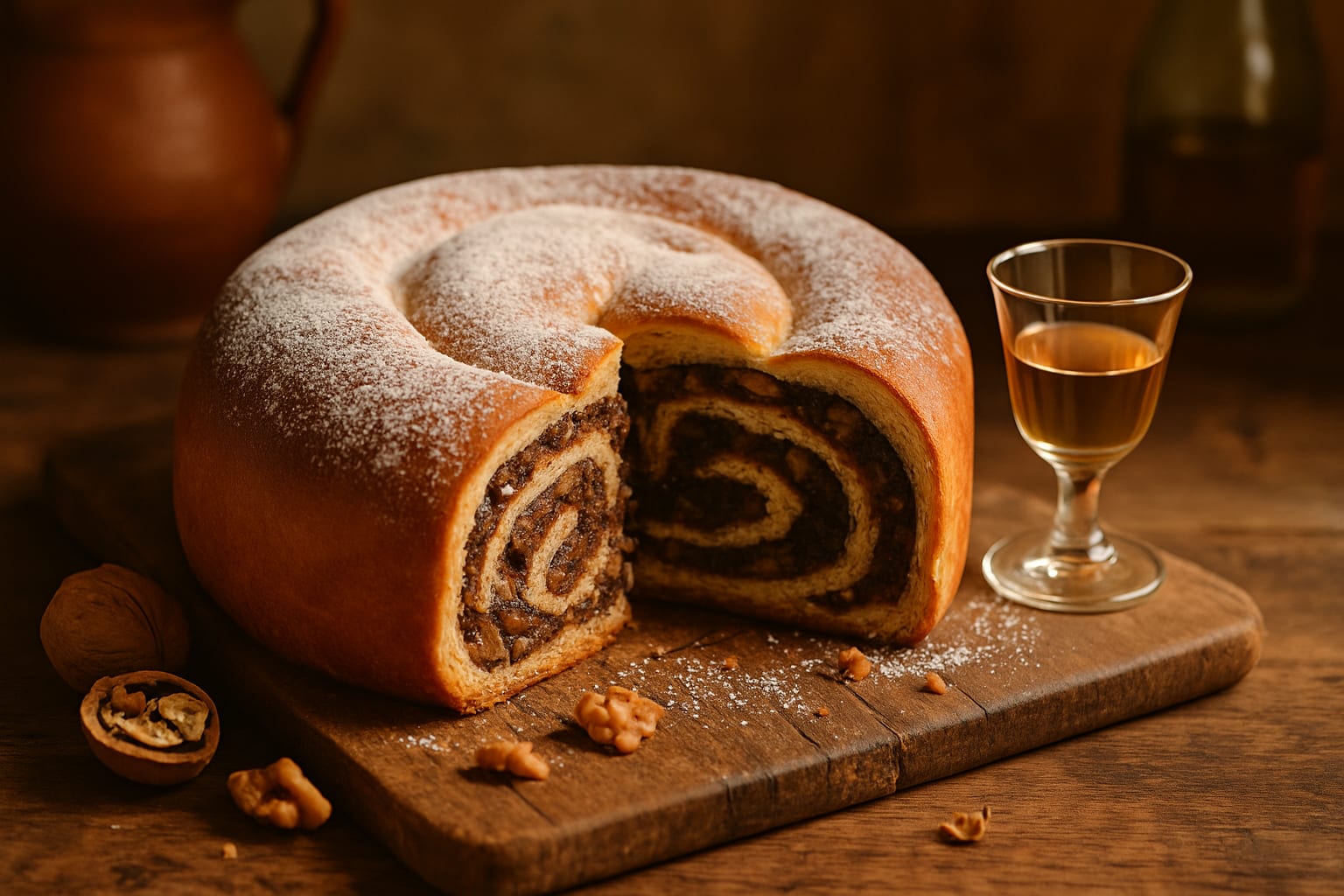
When I was a girl, my mother’s cousin Zia Ada lived up near Cividale, close enough to the Slovenian border that her kitchen smelled half of Friuli and half of somewhere else entirely — walnuts and grappa mixed with a whisper of poppy seed and honey from over the hills. Every Christmas Eve she would send a gubana wrapped in a checkered cloth, still warm, and my father would slice it thin while my mother warmed a little glass of grappa to pour over each piece, the way her own nonna had taught her. I remember pressing my thumb into the spiral on top, counting the coils like the rings of an old tree, and Zia Ada telling me each turn of the dough was a year of good luck for the house. It took me three failed loaves of my own before I understood her secret — patience with the dough, and never, ever rush the rolling. Now when I make gubana in my own kitchen, that same smell fills the house, and for a moment I am eleven years old again, waiting by the door for her parcel to arrive. Follow this gubana friulana recipe step by step and bring the flavours of Friuli-Venezia Giulia into your kitchen.
Ingredients
Method
- Start here, because the raisins need time to drink. Put them in a small bowl with half the grappa and let them sit for at least an hour, longer if you have the patience, until they are plump and soft rather than shriveled and stubborn. This is not a step to rush past — a dry raisin in the filling is a hard little disappointment when you bite into your slice, and the grappa carries its warmth right through the whole gubana as it bakes. While they soak, you can move on to your dough with a clear conscience.
- Warm your milk until it feels like bathwater on your wrist, not hot enough to sting. Stir in a pinch of the sugar and the yeast, then leave it alone for ten minutes until it turns foamy and smells faintly of bread already. This little bowl tells you everything — if it does not foam, your yeast is tired and you should start again with fresh, because no amount of hoping will make a stubborn dough rise later.
- In a large bowl, combine the flour, remaining sugar, and salt, then make a well and add the yeast mixture, whole eggs, egg yolk, softened butter, lemon zest, and vanilla. Bring it together with your hands until it forms a shaggy mass, then turn it onto a lightly floured board and knead for a good ten minutes. You are looking for a dough that is smooth, elastic, and only slightly tacky — press it with a floured finger and watch it spring back slowly. This is a rich, buttery dough, softer than bread, so resist adding too much extra flour or you will lose the tenderness that makes gubana so good to eat.
- Shape the dough into a ball, place it in a lightly oiled bowl, and cover it with a clean cloth. Set it somewhere warm and draft-free — I always used the spot near the woodstove, but the top of a turned-off oven with the light left on works just as well — and let it rest for about two hours, until it has doubled generously in size. Do not peek and prod too often; the dough needs quiet warmth to build its strength, and every time you uncover it you let the warmth escape.
- While the dough rises, combine the chopped walnuts, pine nuts, drained raisins, candied peel, grated chocolate, biscuit crumbs, sugar, melted butter, cinnamon, and the remaining grappa in a bowl. Mix well until it holds together like a coarse, sticky paste — if it seems too dry to spread, add another splash of grappa or a little of the raisin soaking liquid. This filling should taste bold and a little boozy on its own, because once it is rolled thin inside the dough and baked, its flavour mellows considerably.
- Punch down the risen dough and roll it out on a floured surface into a large, thin rectangle, no thicker than a coin — thinner than you think it should be. Spread the filling evenly across the surface, leaving a bare border along one long edge, then starting from the opposite long edge, roll it up tightly into a log, the way you would roll a carpet, sealing the bare edge underneath. Coil this log loosely into a spiral on a parchment-lined baking tray, like a snail shell, and tuck the outer end underneath so it does not spring loose in the oven.
- Cover the shaped gubana loosely and let it rest for another 30 to 45 minutes, just long enough to puff slightly — it should not double again, or the delicate spiral will blur together as it bakes. Brush the surface generously with beaten egg to give it that deep, lacquered shine that makes a gubana look as good as it tastes. Preheat your oven to 180°C / 350°F while it rests, so the oven is properly hot the moment your dough is ready.
- Bake the gubana for 40 to 45 minutes, until it is a deep golden brown and sounds hollow when you tap the base — if the top browns too quickly, lay a piece of foil over it loosely for the last ten minutes. Let it cool on the tray for a few minutes before moving it to a rack, because a warm gubana is fragile and will tear if you rush it. Dust with powdered sugar just before serving, slice it thickly, and pour a small splash of grappa over each piece at the table, exactly as my mother always did — it is the last, warming touch that wakes up every walnut and raisin inside.