
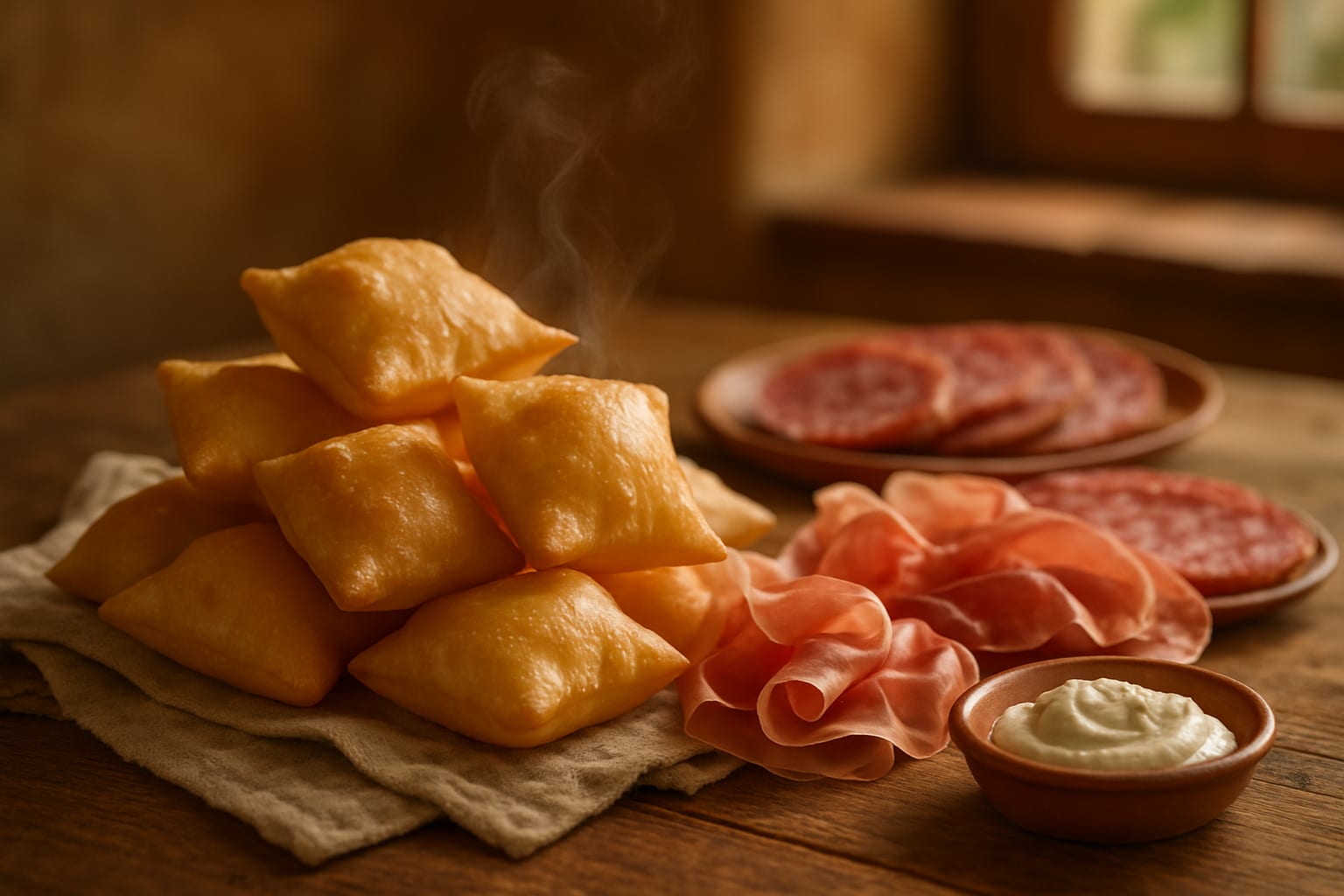
In the hills outside Modena, where my grandmother Fiore learned to cook at her own nonna’s elbow, Sunday afternoons always smelled of hot lard and warm bread. The men would come in from the fields, the fire would crackle, and a great black pan would appear on the stove, filled almost to the brim with fat gone shimmering and clear. Nonna Fiore would drop in small pillows of dough one by one, and within seconds they would puff up like little clouds, golden and blistered, singing as they fried. We called them crescentine in our house, though a few villages over they insisted on gnocco fritto, and the two families argued about it more than they argued about football. It didn’t matter what we called them — the moment they came out of the pan, glistening and impossibly light, everyone reached for one before it even touched the plate, tearing it open to tuck in a curl of prosciutto or a spoonful of soft, tangy squacquerone. My grandmother always said a good gnocco fritto should sound hollow when you tap it, like a little drum, and I have never forgotten that sound. Follow this gnocco fritto recipe step by step and bring the flavours of Emilia-Romagna into your kitchen.
Ingredients
Method
- Warm the milk until it feels like bathwater on your wrist, not hot enough to sting, and stir in the sugar and yeast. Let it sit undisturbed for about ten minutes until the surface turns foamy and smells faintly sweet and alive. This little pause tells you the yeast is strong enough to lift your dough later, and my grandmother never skipped it, even when she was in a hurry, because a dead yeast means a dead gnocco. If nothing bubbles after ten minutes, your yeast is tired and you should start again with a fresh packet.
- Pile the flour onto your work surface or into a wide bowl and make a well in the center. Pour in the frothy milk mixture along with the softened lard, then start drawing the flour in from the edges with a fork or your fingers. Add the salt only once the dough starts to come together, since salt can slow the yeast down if it touches it too early. Keep mixing until you have a shaggy, slightly sticky mass that holds together in one piece.
- Turn the dough out and knead it firmly for a good eight to ten minutes, pushing it away with the heel of your hand and folding it back toward you again and again. At first it will feel rough and tacky, but be patient, because the gluten needs time to develop into long, elastic strands that will trap steam later in the fryer. You will know it is ready when the surface turns smooth and satiny and springs back slowly when you press it with a finger. Nonna Fiore used to say the dough should feel like an earlobe, soft but with life underneath.
- Shape the dough into a ball and set it in a lightly oiled bowl, covering it with a clean kitchen towel. Leave it somewhere warm and draft-free for about two hours, until it has doubled generously in size and feels light and airy when you press it. This slow rise is what gives gnocco fritto its distinctive puff, so resist the urge to rush it along in too warm a spot, or the crumb will turn coarse instead of delicate. When the dough is ready, it will hold a gentle dimple if you poke it and slowly, only slowly, spring back.
- On a lightly floured surface, roll the dough out into a sheet about three to four millimeters thick, roughly the width of a coin. Try to keep the thickness as even as possible across the whole sheet, because thinner patches will fry faster and thicker ones will stay doughy in the center. Using a sharp knife or a pastry wheel, cut the sheet into diamonds or squares about eight centimeters, or three inches, on each side. Gather the scraps gently, re-roll them once, and cut a few more, though these second-pass pieces are always a touch less airy.
- Pour the lard or oil into a deep, heavy pot until it reaches about five centimeters, or two inches, deep, and set it over medium-high heat. Bring it to 180°C (350°F), testing with a thermometer if you have one, or by dropping in a small scrap of dough and watching it rise to the surface and bubble briskly within a few seconds. Fat that is too cool will leave your gnocco greasy and heavy, while fat that is too hot will scorch the outside before the inside cooks through. Keep the heat steady throughout, adjusting as needed between batches.
- Slide two or three pieces of dough into the hot fat at a time, being careful not to crowd the pot, and watch them balloon almost immediately as steam forces its way through the dough. Turn them with a slotted spoon or tongs after about a minute, once the first side is deep golden, and fry the second side for another minute or so. Lift them out onto a tray lined with paper towels to drain briefly, keeping the oven on its lowest setting to hold the first batches warm while you finish the rest. They are best eaten within minutes of frying, while they are still crackling and hollow-sounding when tapped.
- Pile the warm gnocco fritto onto a big wooden board or platter alongside the sliced prosciutto, salumi, and soft cheese. Let everyone tear a pillow open while it steams and tuck in whatever they like best, whether that is a curl of prosciutto, a smear of squacquerone, or simply a bite on its own with nothing at all. In our house this was never a starter or a side, but the whole point of the meal, with everyone gathered close and reaching across the table. Serve immediately, because gnocco fritto waits for no one.