
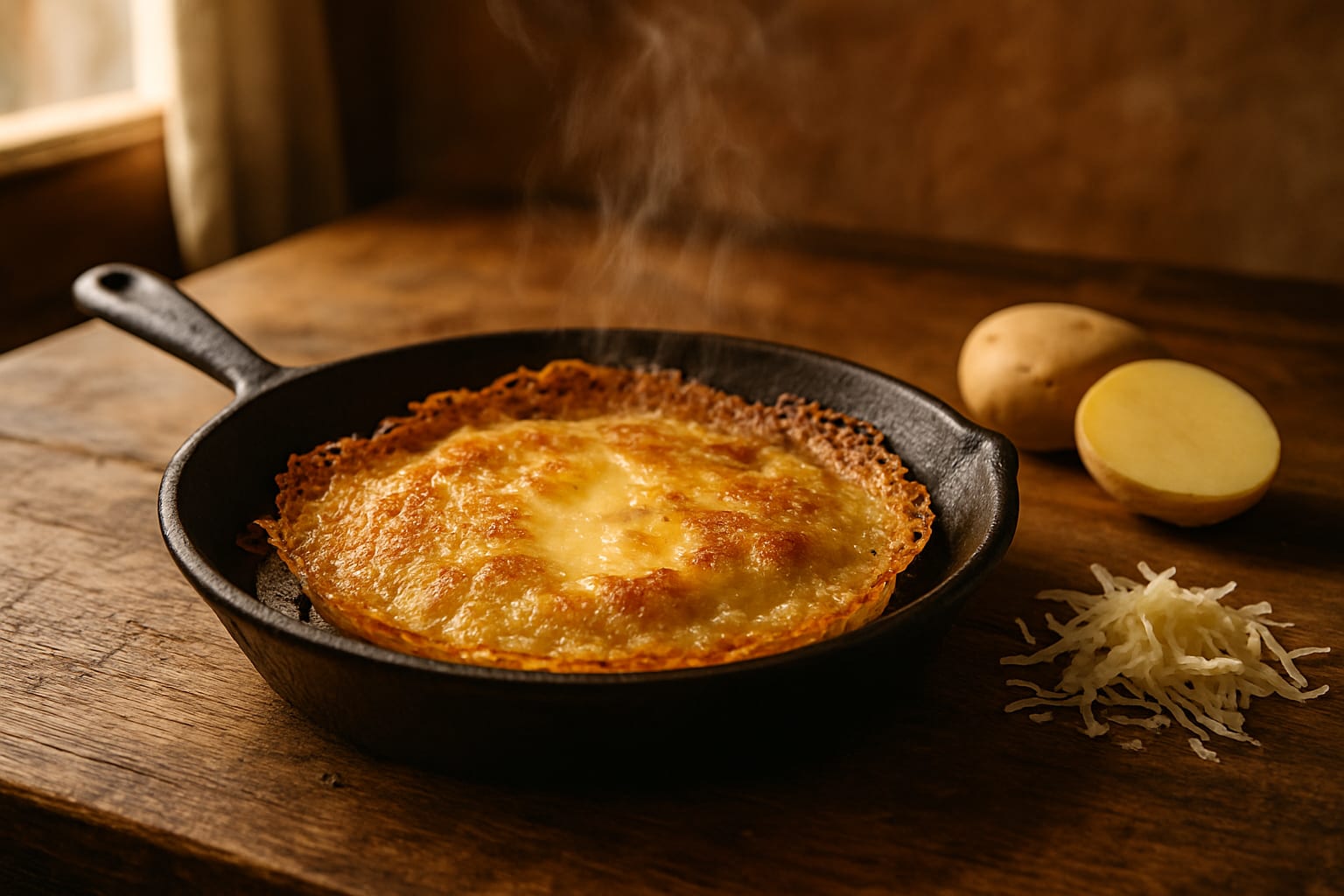
When I was a girl, autumn meant one thing in our corner of Friuli: the cows came down from the high pastures of Carnia, and with them came the wheels of Montasio my zio Beppi traded for polenta flour and firewood. Nothing was ever wasted in that kitchen — not the cheese rinds, not the last wrinkled potatoes at the bottom of the sack, not even the onion that had started to sprout on the windowsill. My grandmother would grate it all together, melt it slowly in her blackened iron pan, and call us in from the cold with the smell alone. Frico was never a fancy dish; it was mountain food, shepherd’s food, the kind of supper that filled you to your boots after a day in the wind. We ate it with our hands sometimes, tearing off golden edges before it even reached the table, arguing over who got the crispiest corner. My grandmother always said a good frico should sizzle like it was angry and smell like a barn full of hay and butter — the highest compliment she knew. Every time I press potatoes and cheese into a hot pan today, I hear her voice telling me to be patient, to let the crust build before I dare touch it. Follow this frico friulano recipe step by step and bring the flavours of Friuli-Venezia Giulia into your kitchen.
Ingredients
Method
- Using the coarse side of a box grater, shred the peeled potatoes the way you would a block of cheese. Grating rather than dicing lets the potato cook through quickly and melt into the cheese almost invisibly, which is exactly what gives this version its soft, custardy centre instead of the all-crisp wafer you might know from other frico. Once grated, squeeze the shreds gently in a clean kitchen towel to remove excess moisture — a damp potato will steam instead of brown, and we want colour, not sog. Set the potato aside in a bowl and don’t worry if it darkens slightly at the edges; that’s just the air talking, and it will vanish once it hits the hot pan.
- Melt the butter in a heavy 24–26 cm (10-inch) nonstick or well-seasoned cast-iron skillet over medium-low heat. Add the sliced onion and a small pinch of salt, and let it cook gently for 8–10 minutes, stirring now and then, until it turns soft, translucent, and faintly golden at the edges. This slow start is not a step to rush past — the onion is the quiet backbone of a good frico, and if you scorch it here, that bitterness will follow the whole dish to the table. My grandmother always said the kitchen should smell sweet, not sharp, before you add anything else.
- Stir the grated, squeezed potato into the softened onion, spreading it into an even layer across the pan. Pour in the 2 tablespoons of water, cover the pan, and let it cook over medium-low heat for about 8 minutes, stirring once or twice, until the potato is tender and no longer tastes raw or starchy when you sneak a taste. The water helps the potato steam through without burning before it’s cooked, so don’t skip it even if the pan looks dry — add a splash more if needed. You want a soft, cohesive mash-like base, not separate crunchy strands.
- Remove the pan from the heat for a moment and scatter the grated Montasio evenly over the potato and onion mixture, along with a generous grinding of black pepper. Fold it through gently with a wooden spoon just until combined — you’re not aiming for a smooth batter, but for pockets of melting cheese laced through the potato. Taste and adjust salt carefully, remembering that Montasio itself carries a good amount of natural saltiness, especially if it’s more aged. Press the whole mixture down firmly and evenly with the back of the spoon to form one compact disc that fills the pan.
- Return the pan to medium heat and let the frico cook undisturbed for 5–7 minutes. Resist every urge to lift, peek, or shake the pan during this time — that stillness is what allows the cheese at the base to brown into a proper crust rather than tearing apart into loose strands. You’ll know it’s ready to flip when the edges pull slightly away from the pan and turn a deep amber-gold, and when you can smell that toasted, nutty aroma my grandmother compared to a barn full of warm hay.
- Slide the frico onto a large plate or flat lid, then place the pan upside down over it and, holding both firmly together, flip the whole thing in one decisive motion so the frico lands back in the pan crust-side up. This is the moment my grandmother turned into theatre, always insisting a nervous flip was worse than a bold one — a quick, committed turn keeps the disc intact far better than a slow, hesitant one. If a little breaks off at the edge, don’t fret; press it gently back into place once it’s back in the pan.
- Cook the flipped frico for another 5–6 minutes over medium heat, again without disturbing it, until this second side is just as deeply golden and crackled as the first. Give the pan a gentle shake partway through to make sure nothing is sticking, adding a small extra knob of butter around the edges if it looks dry. When both sides are properly crisp, the inside will still be soft and molten, which is exactly the contrast this potato-and-onion style is famous for.
- Slide the finished frico onto a wooden board and let it rest for 2–3 minutes before cutting it into wedges like a savoury cake. This short rest lets the melted cheese firm up just enough to hold its shape when sliced, rather than oozing everywhere the moment your knife touches it. Serve it while still warm, ideally with soft polenta, a simple green salad, or nothing at all beyond a glass of Friulian white wine, the way my grandmother always did on the coldest evenings.