
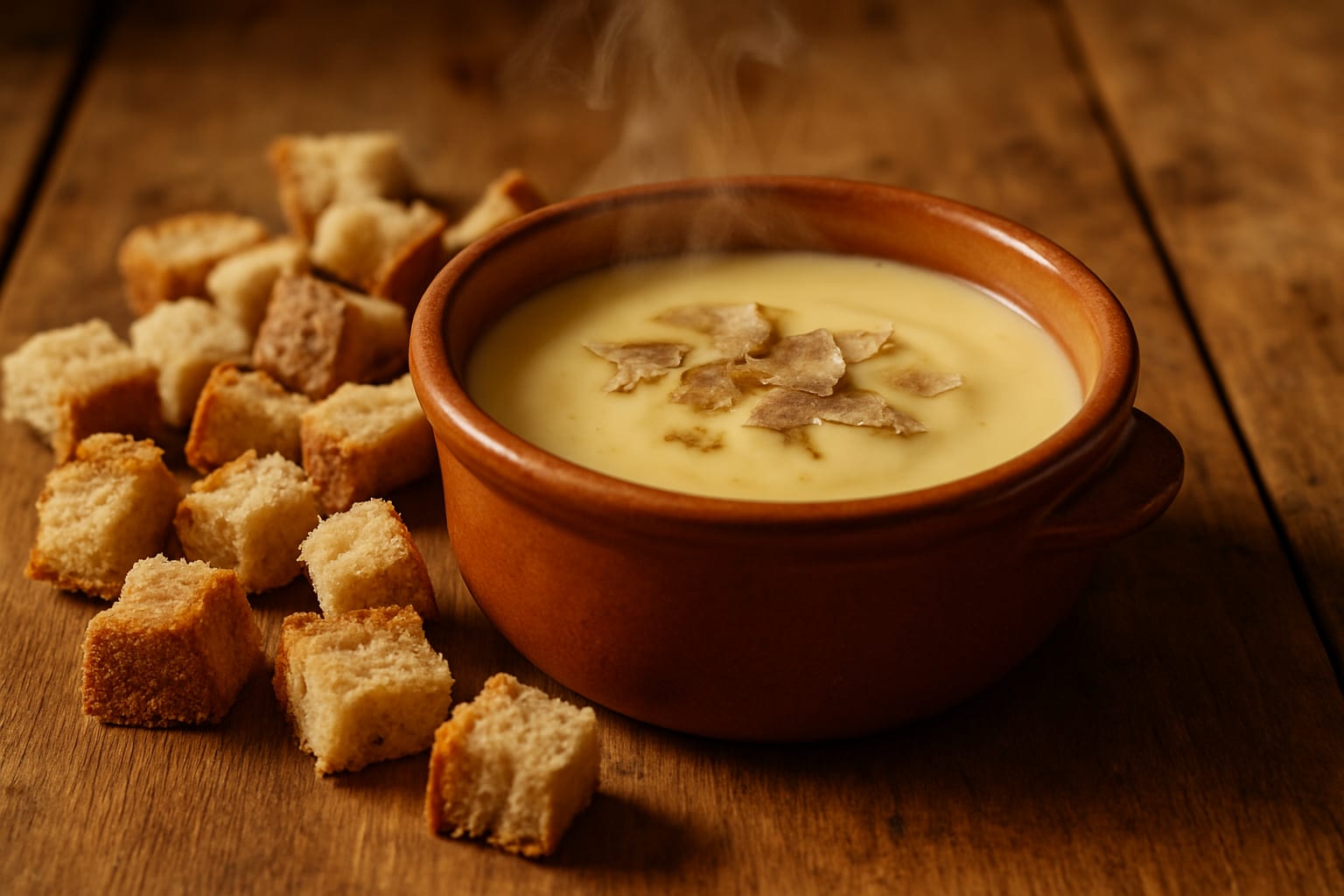
Up in the Aosta Valley, where the mountains rise so steep that the cows seem to graze sideways on the slopes, there is one cheese that matters more than any other: Fontina. Nonna Fiore married into a family with cousins up there, dairy farmers who spent every summer moving their herds higher into the alpine pastures, chasing the sweetest grass. She used to visit as a young bride, and she still talks about the cellars carved into the mountainside where the great wheels of Fontina DOP were left to age, rind darkening, flavour deepening with every passing month. Fonduta is what those mountain families made when the work was done and everyone gathered close to the table on a cold evening — cheese melted low and slow with milk and butter, folded together with egg yolks until it turned into something halfway between a sauce and a warm embrace. No cream, no flour, no shortcuts — just patient heat and a wooden spoon that never stops moving. In the grandest version, a few shavings of white truffle fall over the top like snow, but Nonna Fiore will tell you the dish is just as beautiful without it, eaten simply with cubes of good bread for dipping. It is a dish for sharing, for lingering, for keeping the mountain cold outside the door. Follow this fonduta valdostana recipe step by step and bring the flavours of Valle d’Aosta into your kitchen.
Ingredients
Method
- Place the cubed Fontina in a bowl and pour over the milk so the cheese is fully submerged. Cover and leave to macerate in the refrigerator for at least 4 hours, though overnight is better. This slow soak softens the cheese and lets it start absorbing the milk, which is the secret to a fonduta that melts smoothly instead of turning stringy and tough.
- When you’re ready to cook, choose a heatproof bowl that will sit snugly over a pot of gently simmering water without touching it. Pour the Fontina and its soaking milk into the bowl, keeping back a splash of the milk in case you need to loosen the fonduta later. Set the bowl over the barely simmering water — the water should never boil hard, only whisper.
- Add half the cold butter to the cheese and milk. Using a wooden spoon, stir gently and constantly in one direction as the Fontina begins to soften and melt. This will take longer than you expect — ten minutes or more — and that patience is exactly the point. Resist the urge to raise the heat; a fonduta rushed is a fonduta ruined.
- Once the cheese has melted into a loose, creamy mass, remove the bowl from the heat for a moment. Add one egg yolk, whisking it in quickly and thoroughly before adding the next. Return the bowl to the bain-marie between each addition if the mixture cools too much. Work in all four yolks this way, one at a time, never all at once — this is what keeps the fonduta silky rather than scrambled.
- Return the bowl to the bain-marie and continue stirring gently for another 2-3 minutes, until the fonduta thickens into a smooth, pourable cream that coats the back of the spoon. If it feels too thick, whisk in a spoonful of the reserved milk. Stir in the remaining cold butter at the very end, off the heat, for extra shine and richness. Season with a pinch of salt, if needed, and white pepper.
- Fonduta waits for no one — serve it the moment it’s ready, straight from the bowl or poured into small individual warmed dishes. Shave fresh white truffle generously over the top if you have it, and set out cubes of rustic bread, boiled potatoes, or grissini for dipping. Gather everyone around while it’s still warm and glossy.