
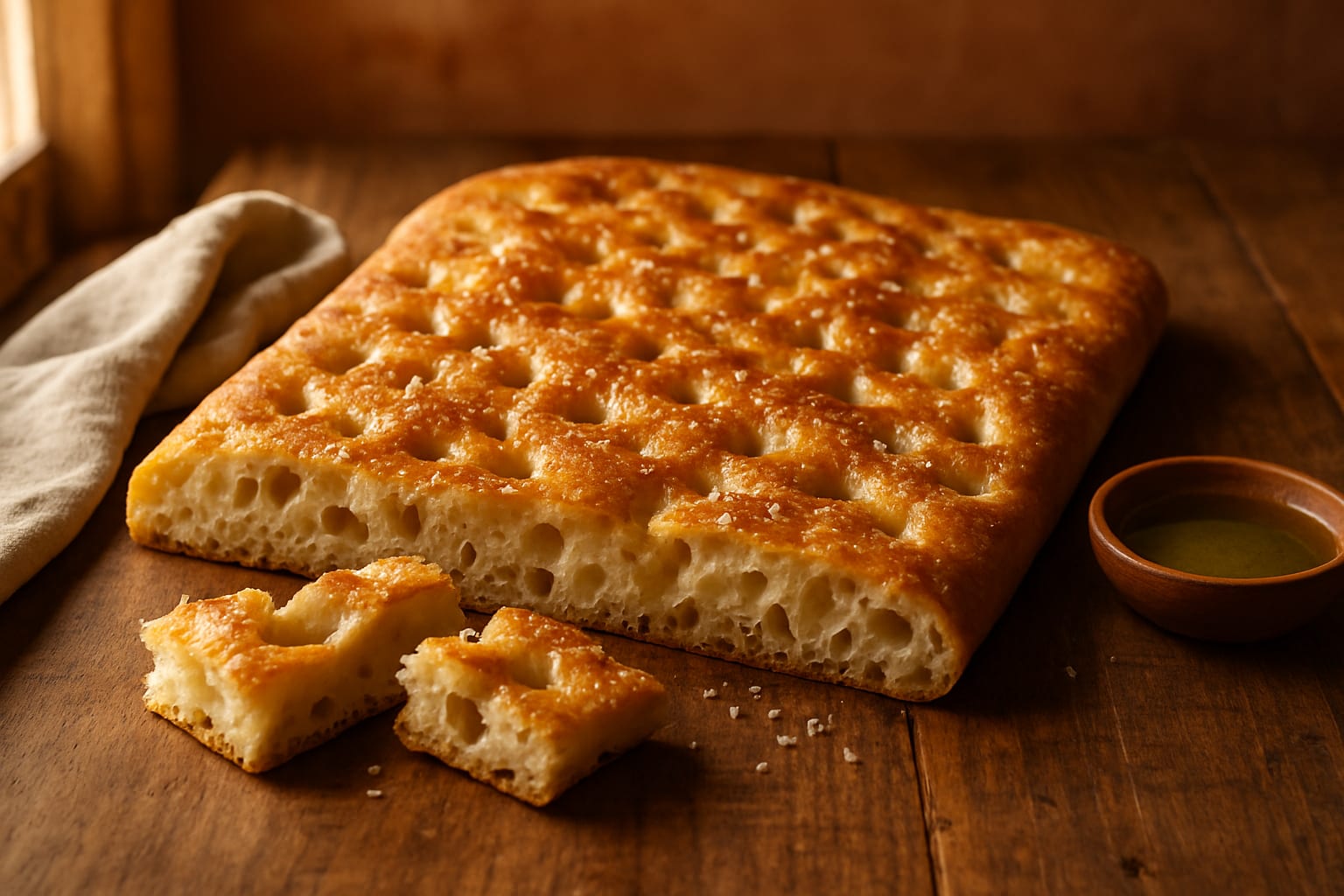
In Liguria, focaccia is not just bread — it is breakfast, it is a snack passed through a bakery window still warm, it is the smell that greets you on every street corner from Genoa to the smallest fishing village. My mother’s cousin lived above a forno in the hills behind the port, and when we visited as children, we were sent downstairs each morning with a few coins to bring back a still-steaming sheet of fugassa, its top glistening with oil and pooled with little lakes of brine in every dimple. We would eat it plain, tearing pieces with our fingers before the flour had even settled on the counter, sometimes dunking corners into cappuccino the way the old Genovesi do without a hint of embarrassment. My own version has traveled with me for sixty years, adjusted a pinch here, a rest there, but it always comes back to the same lesson: patience with the dough, generosity with the oil, and a hand that presses deep enough to hold the brine in every hollow. Making it fills the kitchen with the same salty, golden smell that used to drift up those narrow Ligurian stairs. Follow this focaccia genovese recipe step by step and bring the flavours of Liguria into your kitchen.
Ingredients
Method
- Pour the lukewarm water into a small jug and stir in the sugar until it disappears, then sprinkle the yeast evenly over the surface without stirring again. Leave it undisturbed for about ten minutes, somewhere warm and out of a draft, until the top turns foamy and smells faintly of bread already. This little cloud tells you the yeast is alive and hungry — if it stays flat and quiet, your yeast is tired and you should start again with a fresh packet. I learned this trick from my mother, who never trusted a yeast she couldn’t see working before she gave it good flour.
- Tip the flour into a large bowl and make a well in the centre, then pour in the frothy yeast water along with three tablespoons of the olive oil. Bring the flour in from the edges with your hand or a wooden spoon until a shaggy, sticky dough forms — it should look wetter than you expect, almost too loose to be bread. Cover the bowl with a damp cloth and let it rest for fifteen minutes before you add the salt, since salt slows the yeast down and we always give it a head start first. This short rest also lets the flour drink in the water fully, which makes the kneading ahead much kinder to your hands.
- Sprinkle the salt over the rested dough and knead it right in the bowl or on a lightly oiled counter, using a stretch-and-fold motion rather than heavy pounding, since this dough is far too wet for a floured board. Work it for about eight to ten minutes, and you will feel it change beneath your hands — from a sticky mess into something smooth, elastic, and faintly shiny. Do not be tempted to add more flour just because it clings to your fingers, since a wetter dough is exactly what gives focaccia its open, airy crumb. When you can stretch a small piece thin enough to see light through it without tearing, your gluten is ready.
- Shape the dough into a loose ball, set it in a large oiled bowl, and turn it once so every side is glossy. Cover tightly and leave it to rise in a warm corner of the kitchen for about two hours, or until it has doubled and looks full of little bubbles beneath the surface. In my grandmother’s day, in a house with no heating to spare, this bowl always sat near the stove, wrapped in an old wool blanket like a sleeping baby. Resist rushing this step with extra yeast or a hot spot nearby, since slow fermentation is what gives Genovese focaccia its faint tang and deep flavour, not just its lightness.
- Pour a generous two tablespoons of olive oil onto a rimmed baking sheet, about 33 by 23 centimetres or 9 by 13 inches, and tilt it until the whole surface is coated. Turn the risen dough out onto the pan and, using your oiled fingertips, gently press and stretch it from the centre outward toward the corners. If it resists and springs back, leave it alone for ten minutes to relax before continuing, since dough has a memory and fighting it only tears the structure you worked so hard to build. Work patiently until it fills the pan in an even layer, no thicker than about two centimetres or three-quarters of an inch.
- Cover the pan loosely with a cloth or oiled plastic and let the dough rise again for forty-five minutes to an hour, until it looks puffy and jiggles slightly when you nudge the pan. This second rise is what gives true fugassa its characteristic airy holes rather than a dense, close crumb. Keep the kitchen warm but not hot, and resist peeking under the cloth too often, since every time you lift it you let out the very warmth the dough is relying on. By the end, the surface should look soft and cushioned, almost like a sleeping cat’s belly.
- Dip your fingertips generously in olive oil and press them straight down into the dough, all the way to the pan, in neat rows across the entire surface. This is the single gesture that makes focaccia what it is, so do not be shy, since the deeper the dimples, the more brine and oil they will hold, and the shinier and more flavourful your crust will become. My hands still remember the rhythm my mother taught me, pressing while the dough sighs softly beneath your fingers like it is settling into place. Take your time here, since this is the moment the bread becomes truly Genovese.
- In a small bowl, whisk together the water, olive oil, and coarse salt for the brine until it turns pale and slightly cloudy, almost like a thin vinaigrette. Pour this mixture evenly over the dimpled dough, letting it pool generously into every hollow you pressed, then scatter a final pinch of coarse salt across the top. This emulsion is the secret behind that glossy, almost fried-looking crust and the little bursts of salt in every bite. Let the pan sit for five minutes so the dough can drink up the brine before it goes into the oven.
- Bake in a preheated oven at 220°C (425°F) for eighteen to twenty-two minutes, until the top is deeply golden and the edges have pulled slightly from the pan, crisp and blistered. Rotate the pan halfway through if your oven bakes unevenly, since a focaccia this thin cooks quickly and uneven heat shows itself fast. Let it rest in the pan for five minutes only, long enough to firm up but not so long that the bottom turns soft from trapped steam, before sliding it onto a wire rack. Slice it while still warm, when the crust is at its most fragrant and the crumb is soft enough to pull apart with your hands.