
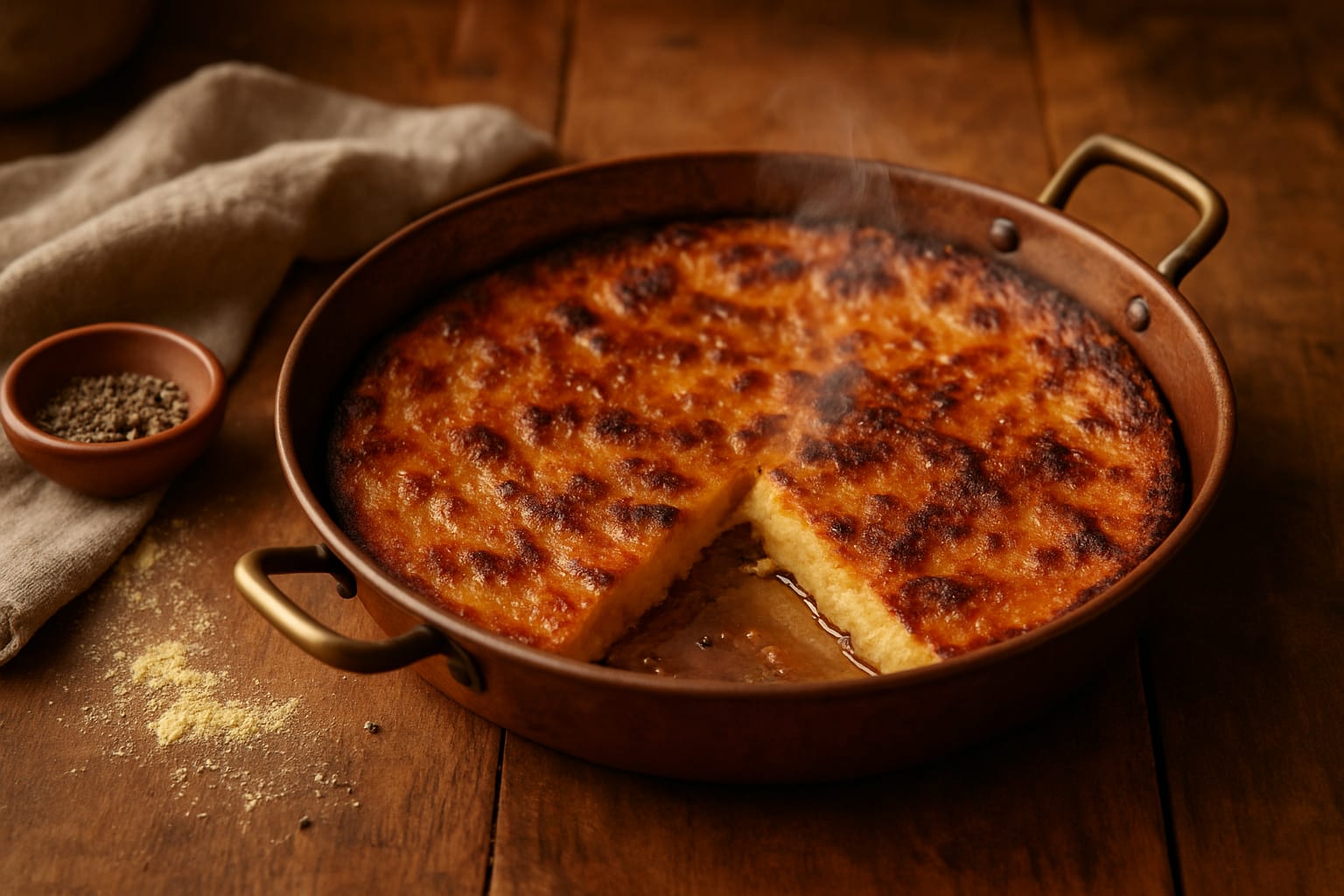
In Genoa, the smell of farinata drifts from tiny hole-in-the-wall bakeries called sciamadde long before you ever see the doorway — a toasty, olive-oil perfume that clings to the cobblestones near the port. My grandmother’s cousin ran one such oven in a narrow vicolo behind the harbor, and when I visited as a girl, he would send me home with a paper cone of farinata wrapped so hot it steamed through the paper. Nonna Fiore always said a Ligurian meal wasn’t complete without a wedge of it, torn — never cut with too much ceremony — and eaten standing up, dusted with black pepper, alongside a glass of cold white wine. She kept an old copper testo, dented and blackened with decades of use, hanging by the stove, and she swore no ordinary baking pan could ever coax out that same lacy, charred edge. Farinata asks for almost nothing — chickpea flour, water, olive oil, salt — yet it rewards patience: the batter must rest, the oven must roar, and the pan must be scorching before batter ever touches it. It is humble food, dockworkers’ food, and Liguria’s proudest bread all at once. Follow this farinata di ceci recipe step by step and bring the flavours of Liguria into your kitchen.
Ingredients
Method
- In a large bowl, combine the chickpea flour with the lukewarm water, whisking constantly to break up any lumps before they can form — this is the single most important step, since chickpea flour clumps stubbornly the moment it meets liquid. Add the water gradually, in a slow stream, whisking without pause until you have a batter the color and thinness of heavy cream. If a few lumps do survive, don’t fight them by hand; pour the batter through a fine sieve into a clean bowl instead. Nonna Fiore always said a smooth batter is what separates a farinata that shatters like lace from one that turns out gluey and dense.
- Cover the bowl loosely and let the batter rest at room temperature for at least 4 hours, though overnight in the refrigerator is even better. As it sits, a layer of pale foam and impurities will rise to the surface — skim this off with a spoon two or three times during the rest, since leaving it in will make the finished farinata taste bitter. This resting time lets the chickpea flour fully hydrate and the raw, dusty flavor mellow into something nutty and rounded. Do not rush this step; it is where the real flavor of farinata is built, long before the oven ever comes into it.
- About 20 minutes before you plan to bake, set your oven as hot as it will go — ideally 250°C (480°F) or higher — and place your copper testo or a well-seasoned carbon-steel or cast-iron pan inside to heat along with it. A farinata pan must be blisteringly hot before the batter ever touches it, or the bottom will steam instead of crisp. If you don’t own a traditional testo, choose the widest, shallowest oven-safe pan you have, since farinata should be poured no thicker than about 5mm (¼ inch).
- Just before baking, whisk the salt and half the olive oil into the rested batter. Carefully remove the scorching pan from the oven, pour in the remaining olive oil, and tilt the pan to coat the bottom completely — it should shimmer and nearly smoke. Pour the batter into the oiled pan in one confident motion; it should sizzle audibly the moment it hits the surface, which tells you the pan is exactly hot enough. Scatter the rosemary leaves over the top if using, along with a light grinding of black pepper.
- Slide the pan onto the top rack of the oven and bake for 15 to 20 minutes, until the farinata is fully set, deeply golden, and pulling away from the edges of the pan. Resist opening the oven door in the first 10 minutes, since a sudden drop in heat can leave the center wet and underdone. You’ll know it’s close when the surface stops looking wet and glossy and starts to blister into small golden bubbles.
- For the lacy, blackened edges Liguria is famous for, switch the oven to broil for the final 2 to 3 minutes, watching closely the entire time. The high, direct heat will darken the raised bubbles and the rim of the farinata to a deep amber-brown, almost burnt in places — this is exactly right, not a mistake. Pull it the moment you see good color, since chickpea batter can go from beautifully charred to bitter in under a minute.
- Let the farinata rest in its pan for just a minute or two, then loosen the edges with a knife and slide it onto a wooden board. Cut it into wide wedges or rough squares while it is still warm, finishing each piece with a final crack of black pepper and, if you like, a light drizzle of fresh olive oil. Farinata is best eaten right away, still warm from the oven, ideally standing at a counter the way Genoese dockworkers have always eaten it, with a glass of cold white wine close at hand.