
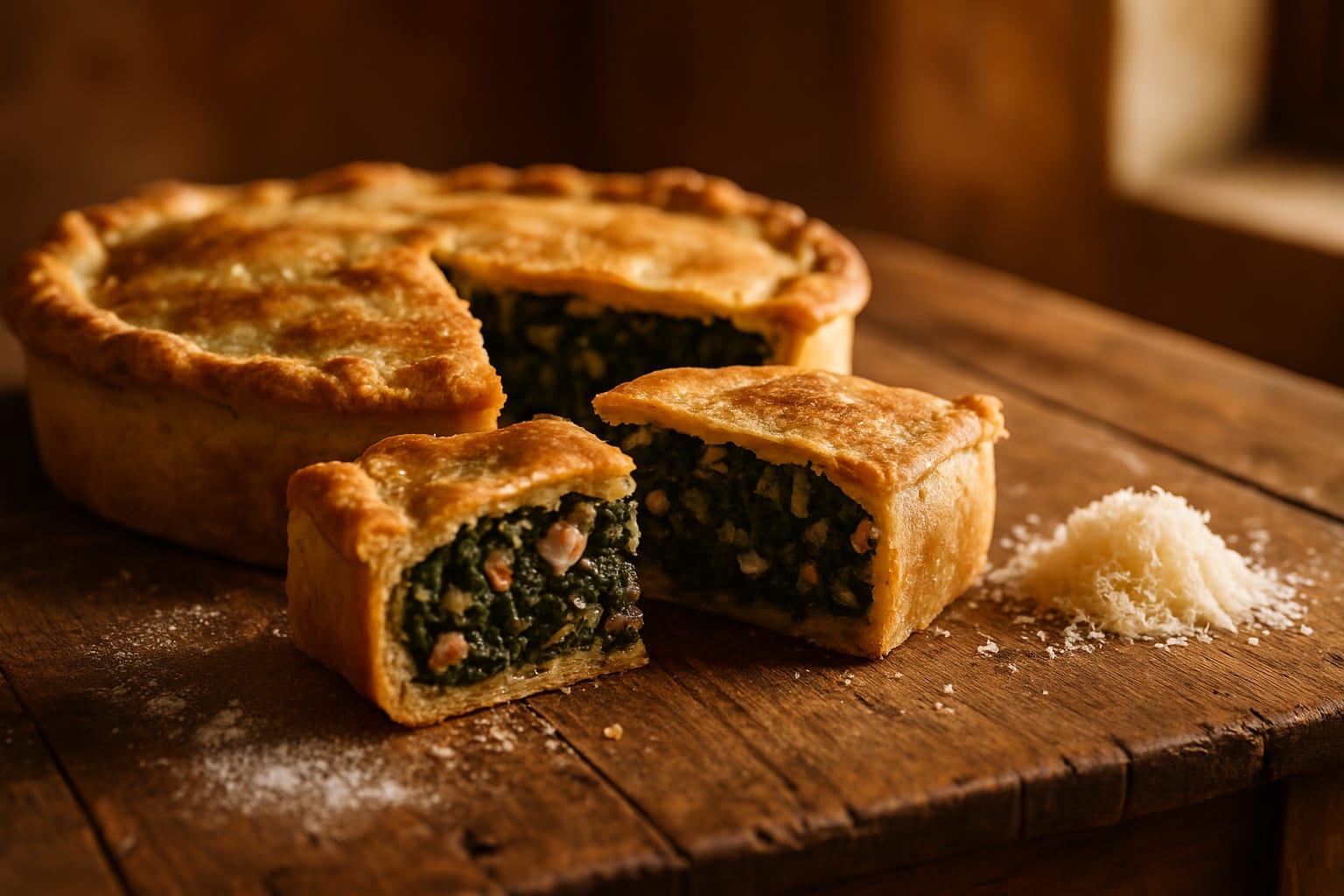
When I was a girl in the countryside near Reggio Emilia, my mother sent us into the fields every autumn morning to gather wild greens along the ditches — bietole, dandelion leaves, whatever the earth gave freely. Nothing was wasted in those years, and erbazzone was born from exactly that spirit: humble greens, a little pancetta if we had it, and a thin crust rolled so fine you could almost read through it. My grandmother baked hers in a blackened tin pan that never left the family, and the whole kitchen filled with the smell of garlic and toasted Parmigiano while it browned. We ate it warm, cut into squares, standing at the table because no one could wait for it to cool. Later it became the pie the men carried to the fields wrapped in cloth, sturdy enough to survive a morning’s work and still taste like home at midday. Even now, when I press the two crusts together at the edges, I hear my mother’s voice telling me to pinch tighter, ‘so nothing good escapes.’ Erbazzone is Reggio Emilia on a plate — practical, green, and deeply proud of its simplicity. Follow this erbazzone reggiano recipe step by step and bring the flavours of Emilia-Romagna into your kitchen.
Ingredients
Method
- In a large bowl, mound the flour and make a well in the centre. Pour in the lukewarm water and olive oil, add the salt, and work everything together with your fingertips until a shaggy dough forms. This is called pasta matta, or ‘crazy dough,’ because it has no eggs and no yeast — just flour, water, and oil, kneaded until smooth and elastic, about eight minutes. It should feel soft as an earlobe, never stiff. Wrap it in a damp cloth and let it rest for thirty minutes so the gluten relaxes; a rested dough will roll out paper-thin without tearing or springing back, which is exactly the texture erbazzone needs.
- Wash the chard or spinach thoroughly, since garden greens hide a surprising amount of grit in their ribs. Cook the leaves in just the water clinging to them, covered, over medium heat for five to seven minutes until fully wilted. Drain in a colander and press hard with the back of a spoon or your hands once cool enough to handle — you want the greens genuinely dry, not damp, because any lingering water will turn your filling soupy and your bottom crust soggy. Chop the greens finely once drained.
- Warm the olive oil or lard in a wide skillet over medium heat and add the pancetta. Let it render slowly until the fat turns golden and the meat crisps slightly at the edges, about four minutes. Add the chopped onion and cook gently until translucent, then stir in the garlic for the final minute only — garlic burns quickly and turns bitter, so it goes in last, never first. This base is what gives erbazzone its savoury backbone beneath all that green.
- Add the drained, chopped greens to the skillet with the soffritto and cook together for three or four minutes, stirring so every strand picks up the garlic and pancetta flavour. Remove from the heat and let the mixture cool slightly before stirring in the grated Parmigiano — cheese added to a still-hot pan can turn stringy and clump rather than binding evenly through the filling. Season with salt, pepper, and if you like, a whisper of nutmeg, which quietly rounds out the earthiness of the greens without announcing itself.
- Divide the rested dough into two pieces, one slightly larger than the other, and roll the larger piece on a lightly floured surface until it is thin enough to see your hand’s shadow through it — traditional erbazzone crust is almost translucent, closer to a strudel pastry than a bread dough. Drape it into a well-oiled 25cm / 10-inch round or rectangular baking pan, letting the excess hang over the edges. Brush the base lightly with olive oil, which keeps the bottom crust crisp rather than gummy once the moist filling sits on top.
- Spread the cooled filling evenly over the base crust, pressing it gently into an even layer right to the edges. Roll out the second piece of dough just as thin and lay it over the filling. Trim the overhang, then fold the edges of the two crusts together and pinch firmly all the way around to seal — my mother’s old instruction to ‘pinch tighter’ matters here, because a poorly sealed edge lets steam escape and the filling can bubble out during baking.
- Brush the top crust all over with olive oil, which is what gives erbazzone its rustic, blistered, almost leathery finish rather than a smooth pale top. Prick the surface a few times with a fork to let steam escape evenly, then bake in a preheated oven at 200°C / 400°F for forty to forty-five minutes, until the crust is deeply golden brown and firm to the touch. The color should be closer to toasted hazelnut than pale gold; a timid bake leaves the pastry soft instead of pleasingly crisp.
- Let the erbazzone rest in the pan for at least ten minutes before cutting — this brief pause allows the filling to settle so your slices hold together instead of spilling when you cut them. Slice into squares or wedges and serve warm or at room temperature; this is not a delicate dish that demands the table, but a sturdy, portable one that travels beautifully in a basket or lunch box, exactly as it always has in Reggio Emilia.