
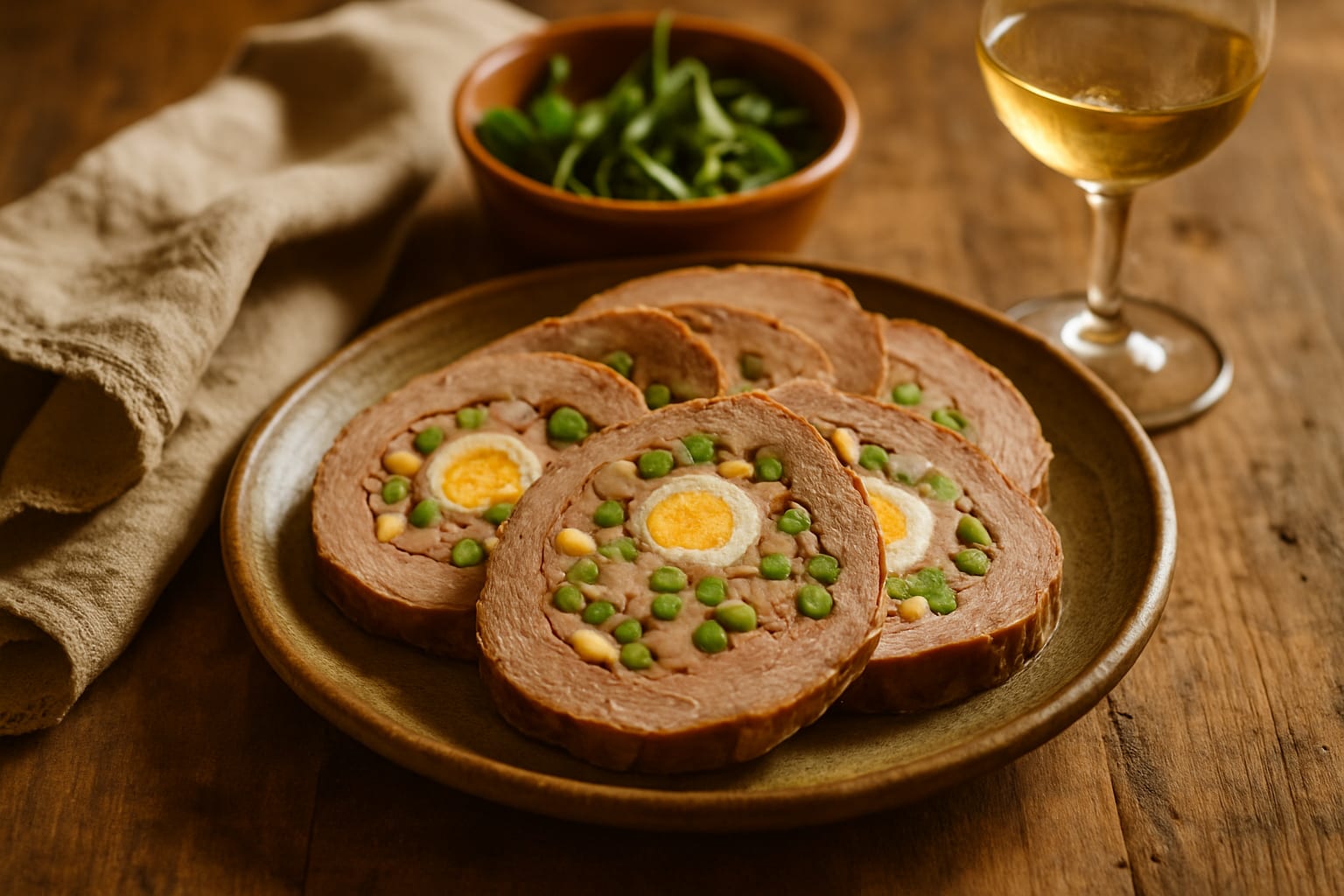
In our house, Easter did not truly begin until the cima was on the table, wrapped in its cloth and cooling on the marble counter where my Nonna Fiore kept her cheeses. She learned it from her mother in a tall, narrow house near the port of Genova, where nothing from the calf was ever wasted — the breast became a pocket, the odd bits of egg and pea and yesterday’s bread became treasure inside it. She would sew the opening herself with kitchen string and a big blunt needle, humming while she worked, telling us that a crooked seam meant a hungry Easter and a straight one meant good luck for the year. The whole kitchen smelled of marjoram and simmering broth for hours, and we were never, ever allowed to lift the lid. When it finally came to the table, sliced thin and cold, you could see the little mosaic inside — yellow egg, green pea, pale pine nut — like a stained-glass window you could eat. It tasted like patience, like family gathered close, like Liguria itself. Follow this cima alla genovese recipe step by step and bring the flavours of Liguria into your kitchen.
Ingredients
Method
- Ask your butcher, as I always did on Thursday mornings before Easter, to butterfly a piece of veal breast into a wide pocket with the fat and skin left on one side to hold everything together. In the old days in Genova this pocket was made from the calf’s own stomach lining, and the filling often included sweetbreads or even a little brain, nothing was thrown away in a Ligurian kitchen. We are making a version any good butcher can help you with today, but I want you to know the old way, because that is where the dish’s soul lives. Trim any very thick fat, but do not skin the pocket, it needs that layer to hold its shape as it simmers.
- Soak your breadcrumbs in the milk while you prepare everything else, this softens them so they melt into the filling rather than sitting like little stones inside your slices. Boil your eggs now too, so they have time to cool and peel cleanly, a warm egg tears its shell and nobody wants a torn egg in a beautiful cima. If you are using the dried porcini, soak them in warm water for twenty minutes, then chop them fine, they bring a forest note that balances the sweetness of the peas. Nonna always said good filling starts with good order on the counter, so line up your bowls before your hands get busy.
- In a large bowl, combine the ground veal, the soaked and squeezed breadcrumbs, the four raw eggs, the peas, pine nuts, Parmigiano, marjoram, garlic, chopped porcini if using, salt, pepper, and nutmeg. Mix with your hands just until everything is evenly combined, overworking it will make the filling dense and rubbery once it cooks, and we want it soft enough to slice like a terrine. Taste a tiny spoonful cooked in a hot pan before you commit, this is the moment to fix the seasoning, not after the whole cima is sewn shut. Fold in the peeled hard-boiled eggs whole or halved lengthwise so that when you slice the finished cima later, you reveal that lovely golden centre running through it.
- Spoon the filling into the veal pocket, packing it in gently but not too tightly, the filling will expand slightly as the eggs cook and a pocket stuffed too full can split at the seams. Arrange the whole eggs so they sit roughly down the centre if you can, this is what gives you that pretty cross-section when you carve the cima later. Thread your needle with kitchen string and sew the opening closed with small, even stitches, the way my Nonna always said a crooked seam brought a hungry year, so take your time here. Once sewn, tie the whole pocket loosely in two or three places around its girth with more string, like a little parcel, to help it keep its shape in the simmering water.
- Place the cima in a large pot with the onion, carrots, celery, bay leaf, and peppercorns, then add cold water to cover it completely by a few centimetres. Bring it up very slowly to the barest simmer, small lazy bubbles only, then partially cover and let it cook gently for about an hour and a half. A hard boil is the enemy of a good cima, it will toughen the meat and can even burst the seams, sending your beautiful filling out into the broth. Keep the pot at a whisper the whole time, checking now and then to skim any foam that rises to the surface.
- About halfway through cooking, prick the cima gently in two or three places with a skewer or the tip of a knife, this lets built-up steam escape and is the single best insurance against a split seam. Near the end of cooking, insert a skewer into the thickest part and hold it there for a few seconds, then touch it to your lip, if it comes out hot and the juices run clear, your cima is ready. If you have a thermometer, look for an internal temperature of around 75°C / 165°F at the centre of the filling. Lift the cima out carefully with two slotted spoons, it will be heavy and delicate at this stage, and let it drain briefly before the next step.
- Wrap the warm cima in a clean kitchen cloth, then set it on a tray or board and place another board or heavy plate on top, weighted down with a couple of full cans or jars. This pressing is what gives cima its neat, sliceable shape rather than a loose, crumbly one, as the filling firms and the layers settle together as they cool. Leave it under the weight at room temperature for an hour, then transfer it, still weighted and wrapped, to the refrigerator overnight. This patience is not optional, a cima sliced while still warm will fall apart, but a cima chilled overnight slices like a fine salame.
- The next day, unwrap your cima, remove the string, and slice it thin with a sharp knife, revealing that mosaic of egg, pea, and pine nut that makes every plate look a little different and a little festive. Serve it cold or at cool room temperature, exactly as it has always been served for Easter in Liguria, alongside a simple green salad or some lightly dressed steamed vegetables. Any extra keeps beautifully in the refrigerator for three or four days, and in my house it rarely lasted that long, everyone came back for a second slice. This is a dish made to be eaten slowly, standing in a sunny kitchen with the people you love, which is exactly how Nonna Fiore intended it.