
In the hills south of Torino, Sunday lunch was never really about Sunday. It was about Saturday’s roast, and what clever hands did with what was left of it. Nonna Fiore learned this trick from her own mother, standing on a stool by the marble table in the farmhouse kitchen, watching the scraps of a slow-cooked beef and pork roast disappear into something far more precious than they had been the night before. Nothing was wasted in Piemonte, she always says — not the meat, not the braising juices, not even the cabbage leaves that had simmered alongside it. Everything found its way into a filling so fine it had to be pressed through her fingertips to check it was smooth enough. Then came the part she loved best: not cutting the pasta with a wheel, as they do everywhere else, but pinching each little parcel closed between thumb and forefinger — il plin — so that each one stood up on the board like a tiny pleated purse. It is slow work, the kind that fills an afternoon with flour dust, family gossip, and the smell of butter and sage warming on the stove. Nonna Fiore insists the secret is patience, not skill, and that anyone willing to sit at the table long enough will eventually get the pinch right. Follow this agnolotti del plin recipe step by step and bring the flavours of Piemonte into your kitchen.
Ingredients
Method
- Begin this recipe the day before you plan to serve it, because the filling needs a long, slow cook and a full night in the refrigerator to firm up properly. Heat the olive oil and butter in a heavy pot and brown the beef, pork, veal and crumbled sausage in batches over medium-high heat, so the meat colours rather than steams. Set the meat aside, then soften the onion, carrot and celery in the same pot, scraping up the browned bits from the bottom, as this is where much of the flavour lives. Return the meat to the pot, add the garlic, rosemary, sage and bay leaf, then pour in the wine and let it bubble for a minute to cook off the sharp alcohol edge. Add enough stock to come halfway up the meat, cover, and simmer very gently for about two hours, topping up with stock if the pot looks dry, until the meat is so tender it falls apart with a fork.
- Lift the meat out of the pot and let it cool completely — do not skip this step, as warm meat will turn the filling greasy and impossible to bind. Strain and reserve the braising liquid separately for serving later. Once cool, pass the meat through a meat grinder fitted with a fine disc, or pulse it in short bursts in a food processor, along with the blanched cabbage, until the mixture is almost paste-like with no large fibres remaining. This fineness is what separates a refined plin filling from a rustic ragù; it should hold together smoothly when pressed between your fingers.
- Transfer the ground meat and cabbage to a bowl and mix in the grated Parmigiano, eggs, a generous grating of nutmeg, salt and pepper. Work it with a spoon or your hands until it comes together into a firm, cohesive paste — if it feels loose, add a little more cheese; if it feels dry, a spoonful of the reserved braising liquid will loosen it. Taste a small cooked spoonful (fry it briefly in a pan) and adjust the seasoning, since this is your only chance before it is sealed inside the pasta. Cover and refrigerate overnight; a cold, firm filling pipes far more cleanly than a warm, soft one and keeps the delicate pasta from tearing.
- On a clean work surface or in a large bowl, mound the flour and make a well in the centre. Add the egg yolks, whole eggs and salt to the well, and use a fork to gradually draw the flour in from the edges. Once a shaggy dough forms, knead by hand for eight to ten minutes until it becomes smooth, elastic and slightly glossy — it should spring back gently when pressed. This dough is richer in yolks than an everyday tagliatelle dough, which is deliberate: the extra fat makes it supple enough to be rolled paper-thin without splitting, essential for pasta this delicate. Wrap the dough tightly in plastic and let it rest at room temperature for at least 30 minutes.
- Divide the rested dough into four pieces, keeping the pieces you are not using covered so they do not dry out. Working with a pasta machine, pass each piece through the rollers repeatedly, folding and narrowing the setting each time, until you reach the thinnest or second-thinnest setting — the sheet should be so thin you can almost see your hand through it, since agnolotti del plin are traditionally rolled thinner than most other stuffed pastas. Lay the finished sheets on a lightly floured surface and work quickly, as thin sheets dry out fast and become difficult to seal.
- Spoon the chilled filling into a piping bag fitted with a plain round nozzle, or use a sturdy freezer bag with the corner snipped off. Pipe a thin, continuous line of filling about two centimetres from the long edge of a pasta sheet, using roughly a teaspoon’s worth every three centimetres. Fold the far edge of the sheet over the filling to meet the near edge, then press down firmly along the length of the strip with the side of your hand, pushing out any trapped air as you go — trapped air is the main reason agnolotti burst open in the boiling water, so take your time here.
- This is the step that gives the dish its name. Using your thumb and forefinger, pinch the sealed strip firmly at even intervals — about two centimetres apart — pressing the dough together between each mound of filling to seal it and create a defined waist. Then use a fluted pastry wheel or knife to cut through the centre of each pinch, separating the strip into individual little parcels that should look like tiny pleated cushions standing upright on the board. Traditional plin are pinched by hand one at a time rather than cut freely with a wheel, which is what gives them their distinctive ruffled, almost quilted edge and their small, bite-sized shape, quite different from a large square ravioli. Lay the finished agnolotti on a floured tray in a single layer as you work.
- Bring a large pot of well-salted water to a gentle boil — a rolling boil can knock the delicate parcels apart, so keep it at a lively simmer instead. Because the pasta is rolled so thin and the filling is already fully cooked, agnolotti del plin need only two to three minutes to cook through; they are ready when they float to the surface and the pasta turns silky and translucent at the edges. Lift them out gently with a slotted spoon or spider rather than tipping them into a colander, to avoid tearing.
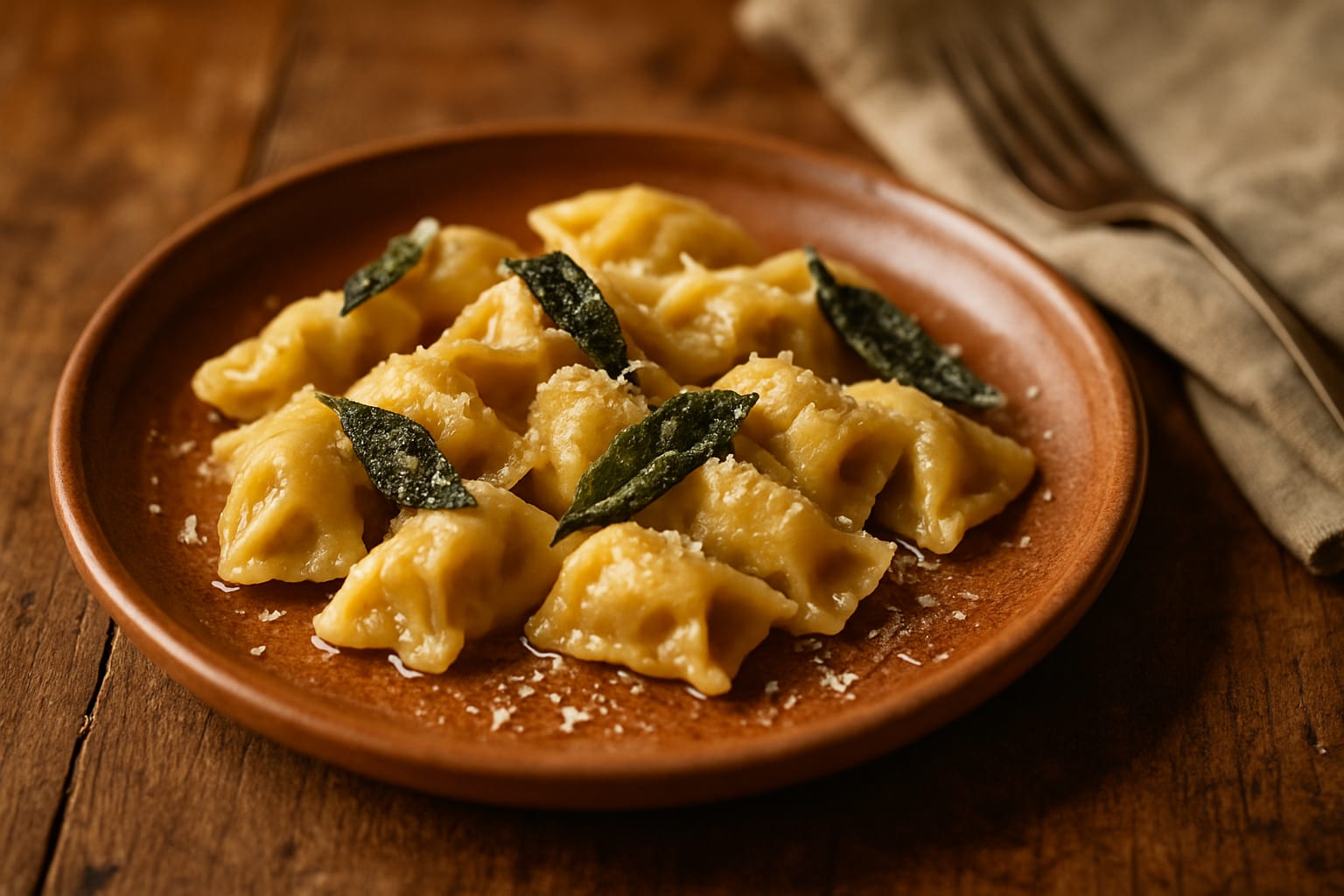
- While the pasta cooks, melt the butter in a wide pan over low heat and add the sage leaves, letting them sizzle gently until fragrant and the butter turns a light golden colour with a faintly nutty smell. If you saved some of the braising liquid from the meat, stir a spoonful or two into the butter for extra depth — this is how many Piemontese families serve their plin, moistened with the same juices that flavoured the filling in the first place. Add the drained agnolotti directly to the pan and toss gently for thirty seconds to coat them evenly without breaking the delicate seams.
- Divide the agnolotti among warmed plates in a single layer rather than piling them up, so the pinched edges stay visible and the sauce doesn’t pool and soften the pasta. Finish with a generous grating of Parmigiano-Reggiano and a final sage leaf or two from the pan. Serve at once, while the butter is still glossy and the pasta is at its most tender — agnolotti del plin wait for no one, and Nonna Fiore always says a plate left sitting too long forgives nothing.